
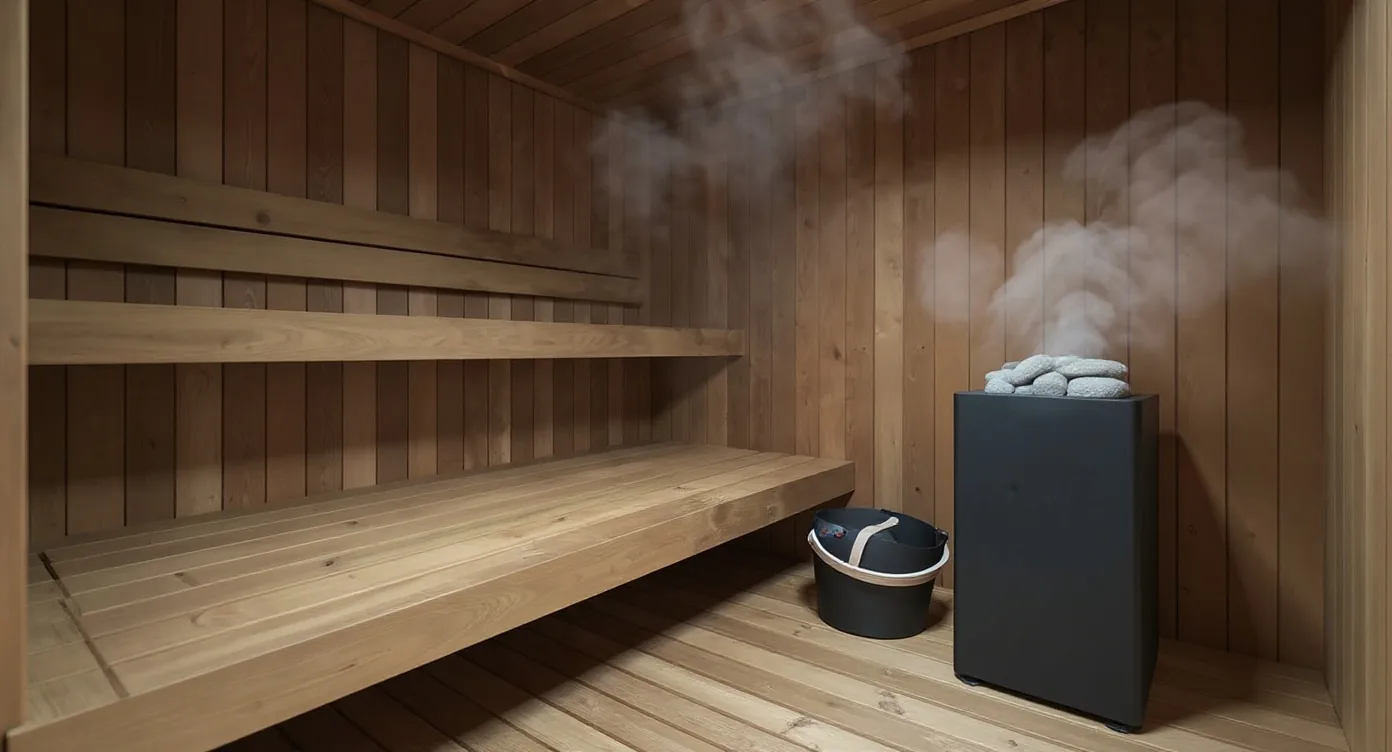
BIO sauna (often also called a soft sauna) is the middle path between Finnish sauna and steam bath — not a compromise, but a deliberate choice of mode for a different physiological goal. Lower temperature, higher controlled humidity, longer sessions. Where Finnish sauna works through oscillation (dry air interrupted by löyly waves), BIO works through continuity — steam is constantly present, the air remains humid, and intensity is even throughout the entire session.
This article assumes that → Sauna ritual has already been read and focuses on BIO-specific points: how the definition (45–60°C, humidity 40–65%) changes practice, why BIO requires different hardware (Combi heater), who it suits more than Finnish sauna, and what the protocol looks like when there is no classic bipolar structure.
Step 01What defines a BIO sauna
Three variables define a BIO sauna, differently from Finnish sauna.
Temperature: 45 to 60°C. Significantly lower than Finnish sauna. This is not a “bad” sauna, but a different physiological regime — the body does not enter the same thermal stress mode as in Finnish sauna, but it still experiences prolonged vasodilation and sweating. Less aggressive, sustainable for longer.
Humidity: 40 to 65%. The middle between Finnish sauna (5–20%) and steam bath (~100%). Humidity is continuous, not pulsating — it is maintained constantly during the session thanks to the steam generator. This is the key distinguishing element of BIO mode.
Source of heat and humidity: Combi heater. A hybrid configuration — stones on the heater maintain the basal temperature, while the integrated steam generator adds continuous steam from a water reservoir. Without this hybrid, there is no BIO mode.
The resulting character is continuous and soft. The body enters a stable state within 8–10 minutes and remains there throughout the whole session. No löyly pulsation, no air oscillation. Steam is constantly present, perceived temperature is even, sweating gradual.
History of the name. The word “BIO” in the sauna context is of German origin — the Biosauna trend appeared in the late 1990s in Germany and Austria as a response to demand for a gentler alternative to Finnish sauna. It is not a Nordic tradition, but a European modernization of sauna culture. This is important for understanding the mode: BIO is not a “real” Finnish sauna at lower temperature, but a deliberately different product with its own purpose.
Step 02Technical anatomy — Combi heater
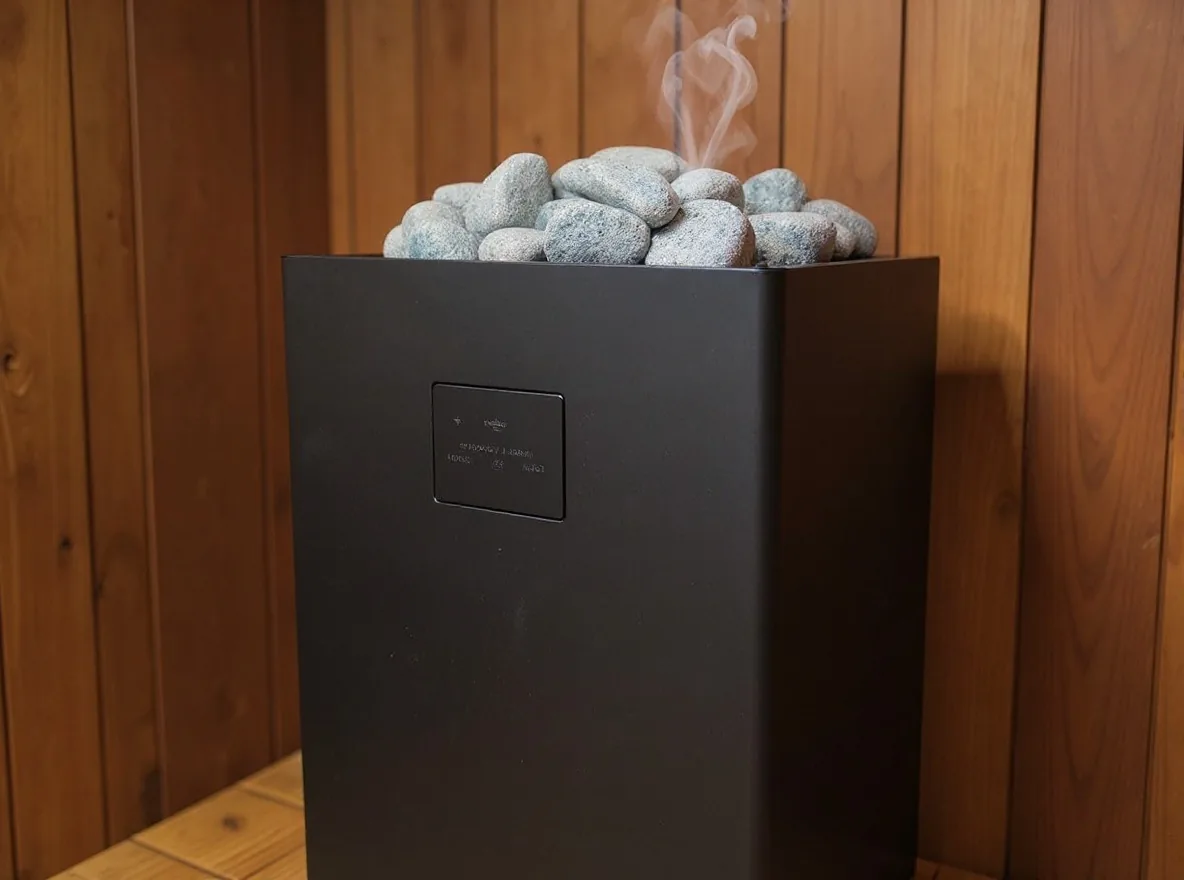
BIO mode requires specific hardware. A standard sauna heater cannot produce BIO mode because it has no integrated steam generator — it can only heat the air and support löyly by pouring water, which is a Finnish configuration.
Combi heater is a hybrid unit: a standard sauna heater with stones plus an integrated steam generator (water reservoir with its own heating element that releases steam continuously throughout the session). It is controlled through a single controller that manages both systems simultaneously — temperature and humidity are set independently.
How BIO mode works technically:
- The main heater warms the stones and the air to 45–60°C
- The steam generator heats water in the reservoir and releases steam through a dispersion nozzle
- The humidity sensor controls the steam generator — it turns it on when humidity falls below the set point and turns it off when the target value is reached
- The result is stable humid air throughout the entire session, without user intervention
KUBIQ Combi configurations:
- HUUM CORE Combi — standard optional configuration for KUBIQ saunas
- SIOP with steam module — ecoReg ClearVision controller supports BIO mode as a separate function
Step 03Who BIO sauna is suitable for
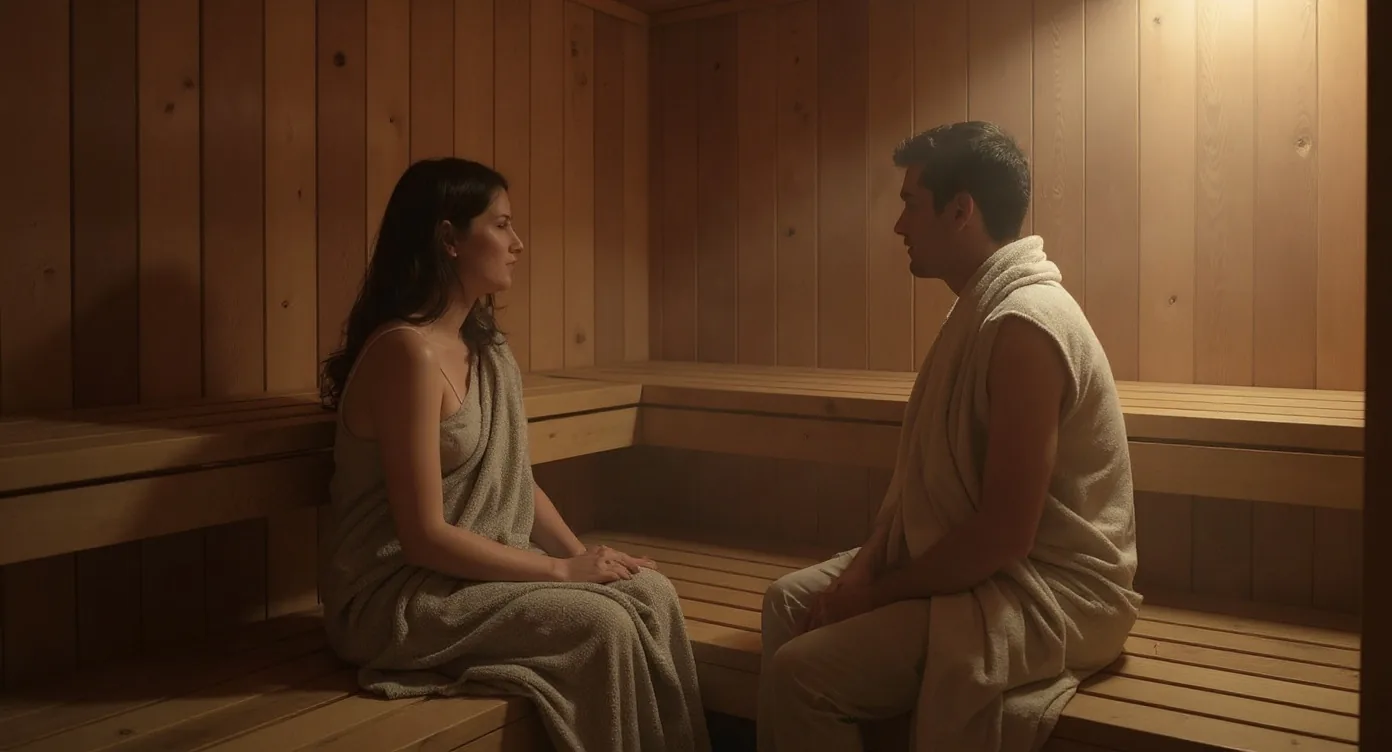
BIO mode has primary target groups — user categories for whom this regime brings a concrete advantage over Finnish mode.
People sensitive to high temperatures. Older users, those with low tolerance for thermal stress, users returning to saunas after a longer break. BIO provides a recovery effect without the aggressive stress required by Finnish sauna.
Family use with children. Children tolerate BIO better than Finnish sauna. Rule: not younger than 6 years, shorter sessions (10–15 min), always under adult supervision, exit at the first sign of discomfort. Lower temperature means lower risk of dehydration and overheating in smaller bodies. Finnish sauna with its 80°C+ is not for children, regardless of the tradition of some cultures.
Users who prefer longer passive sessions without aggressive cycles. Where Finnish sauna requires 2–3 sessions of 10–15 min with breaks, BIO can be done as 1 or 2 sessions of 30–45 min. Less fragmented, more “in the state”.
Sauna before sleep. BIO is less stimulating than Finnish sauna — lower temperature does not activate the sympathetic nervous system as aggressively as 85°C air. Finishing the ritual 1–2 hours before sleep with BIO mode has no negative effect on sleep for most users; Finnish sauna 30 min before sleep can make sleep harder because the body has not yet completed thermoregulation.
Sensitive airways. Humid air is more pleasant than dry Finnish air for some users — less irritation of mucous membranes. This is not medical advice and does not change the fact that anyone with a respiratory diagnosis needs medical advice before sauna practice.
Aromatherapy focus. Continuous steam carries scents constantly in the air, which creates a different aromatherapy experience from the pulsating löyly waves in Finnish sauna — more on that in §5.
Step 04Typical BIO protocol
The general cycle from topic 1 applies here too, but BIO requires a different rhythm.
Main differences from the Finnish model:
- Fewer cycles, longer sessions — typically 1–2 cycles of 30–45 min instead of 2–3 cycles of 10–15 min
- Less aggressive cooling — a lukewarm shower or room air is enough. Cold plunge is not optimal: the contrast is smaller, so the effect is weaker than in combination with Finnish sauna
- Shorter rest — 5–10 min vs. 10–15 in Finnish sauna. The body is not in such deep thermal stress, so it returns to baseline faster
Typical BIO cycle:
- Heating the sauna (30–45 min) — temperature + humidity reach the set point
- First session (30–45 min) — sitting or lying, regular breathing
- Cooling (3–5 min) — lukewarm shower, optionally briefly cold
- Rest (5–10 min) — hydration 200–300 ml
- Second session (20–30 min, optional)
- Finish — shower, drying, lying down 10–15 min
Total duration: 45–90 min, often shorter than Finnish sauna with three cycles.
What to expect physiologically:
- Heart rate: 90–110 bpm (milder than Finnish 110–130)
- Sweating: gradual, even, less abundant than in Finnish sauna
- Breathing: calm throughout the entire session, without sudden changes
The character of the session is more “prolonged relaxation” than a “stress-recovery cycle”. That is the designed physiological goal of BIO mode, not a deficiency. Whoever wants intense cardiovascular training through sauna chooses Finnish. Whoever wants prolonged thermal relaxation chooses BIO.
Step 05Aromatherapy and phytotherapy in BIO mode
Aromatherapy in BIO mode works differently than in Finnish sauna — and this is one of the most prominent practical differences between the two modes.
In Finnish sauna, scents are added to the water used for pouring over the stones, released in waves together with löyly steam, intensely and in pulses. The experience is intense and short-lived — the scent comes in a wave, evaporates, returns with the next pour.
In BIO sauna, scents are added to the steam generator reservoir (not onto the stones) and are released continuously through steam. The experience is constant and even — the scent is continuously present in the air during the entire session.
Practical consequences:
- Dosing is lower per addition, but higher in total across the session
- Scents should be milder — intense ones become tiring over 30+ min sessions
- Layering essential oils is riskier — continuous evaporation means they cannot easily be “released” from the space
Phytotherapy with dried herbs. Combi heaters often have grilles above the evaporator intended for dried medicinal herbs — chamomile, lavender, mint, eucalyptus in dry form. Continuous steam passes through the dry herbs and naturally carries scents through the space during the entire session. This is a traditional Central European approach that has no equivalent in Finnish sauna (stones at 350°C would ignite any dry herbs on contact).
Seasonal recommendations for BIO:
- Winter: eucalyptus in milder concentration, birch
- Spring/summer: lavender, chamomile (relaxation in the warm season)
- Autumn: lavender, vanilla (softer, not intense forest scents that become tiring in BIO mode)
What to avoid:
- Undiluted essential oils in the steam generator reservoir — may damage the heating element
- Synthetic scents and commercial products of questionable origin
- Alcohol-based aromatic bases (risk of toxic vapour evaporation)
KUBIQ Combi heaters have a specific scent reservoir that is separate from the main water reservoir — use according to the heater manufacturer’s instructions.
Step 06Differences from other modes
| Feature | Finnish | IR | BIO |
|---|---|---|---|
| Temperature | 75–90 °C | 35–65 °C | 45–60 °C |
| Humidity | Low (dry) + löyly pulses | Very low (dry) | High (40–60 %) |
| Session duration | 10–15 min × 2–3 cycles | 20–30 min once | 15–25 min × 2 cycles |
| Mechanism | Convection through hot air | Direct IR radiation on skin | Convection + steam from vaporizer |
| Sensation | Intense, cardiovascular | Gentle, dry, penetrating | Softer, humid, protective |
| Typical goal | Classic ritual, cardio stress | Recovery, lower intensity | Wellness, stress regulation |
A detailed comparison is covered in → Combining modes. Practical choice in a weekly rhythm:
- BIO for evening sessions and before sleep — low stimulus, long relaxation
- BIO for family use with children (with age limit and supervision)
- BIO as a “backup” option the day after an intense → Finnish sauna, when the body is not ready for another thermal stress
- Finnish + BIO + IR combined through the week — full spectrum of thermal regimes
BIO ≠ steam bath. A common misconception. A steam bath works at ~100% humidity and requires a ceramic or stone interior because wood cannot tolerate complete water saturation. BIO sauna keeps the wooden interior and sauna atmosphere, but through humidity control (never above 65%) enables a softer experience without risk to the wooden structure.
Step 07Safety specific to BIO
BIO is milder than Finnish sauna, but it is not harmless. Specifics arise from longer sessions and continuous steam:
Dehydration. Longer sessions mean more fluid loss through sweating, even at lower temperature. Hydration standard for BIO: 0.5 l of water 30 min before, 0.3–0.5 l during or after a 45 min session. Do not wait for the feeling of thirst — thermoregulation changes perception.
Overheating with excessively long sessions. It is a myth that BIO “cannot overheat”. It can — the process is just slower. Signals are headache, nausea, loss of focus. No more than 45 min per session for an untrained user, 60 min absolute maximum.
Bacterial risk with poorly maintained steam generator. Standing warm water is an ideal medium for bacteria. Reservoir hygiene:
- Empty the reservoir after every session
- Descale periodically (every 1–2 months depending on water hardness)
- Never leave standing water for more than 24 hours
- Use soft or filtered water — less scale, lower bacterial risk
Reduced visibility because of dense steam. More than in Finnish sauna. Caution when moving in the sauna, use handrails when standing up, exit gradually.
Pregnancy, cardiovascular diagnoses. Generally better tolerated because of lower temperature, but individual medical advice is mandatory — especially in the first trimester.
Step 08Next step
BIO sauna is a deliberate choice of mode for another type of ritual — softer, longer, more accessible for family use. The Combi heater as a hardware prerequisite is a decision made when configuring the sauna, not afterwards.
→ How to choose the right sauna — configuration guide
Thinking about your own sauna?
KUBIQ produces outdoor saunas in two tiers:
- kubiq.eu — standard models and configurations
- studio.kubiq.eu — bespoke, integrated wellness solutions
Explore the models or arrange a consultation — the first step is a conversation, not an offer.