
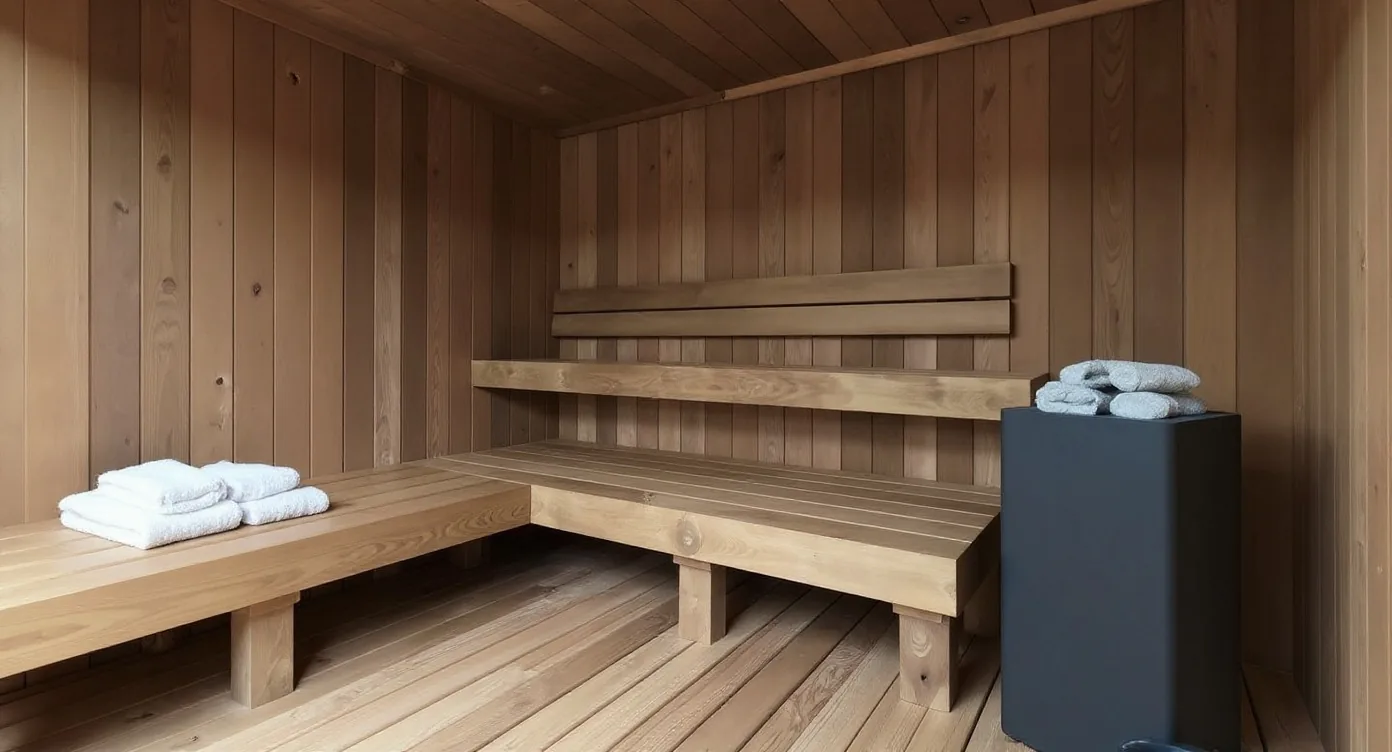
Most texts about sauna offer an “optimal plan”. For whom it is optimal is rarely the question that follows.
This article does not offer a universal schedule. It offers three reference profiles — an athlete in recovery, a regular user without a clinical goal, and a family sharing the practice — and shows what their week can look like. The profiles are templates for adaptation, not prescriptions.
What really determines the week: body, schedule, season. The tables that follow are a starting point, not the answer.
This article assumes that → Sauna ritual and → Combining modes have already been read. The logic of why to mix modes is developed there — here that logic is taken as given.
How to read these examples
Each profile has a weekly table with a suggested schedule, key principles specific to that profile, and a seasonal note. The tables should be read as templates — moving days, skipping a session, or adding a fourth session if the week requires it is all part of normal adaptation. A plan forced regardless of body signals is not a ritual but a debt.
Profile 1: Recovery athlete
Context: amateur athlete, 4–6 training sessions per week, mix of cardio and strength work. The goal is not extracting performance gains from the sauna — the goal is recovery, sleep quality, and stress regulation between training blocks.
Weekly plan
| Day | Training | Sauna | Comment |
|---|---|---|---|
| Mon | Strength (lower body) | BIO 60–70 °C, 2× 12 min | Min. 90 min after training |
| Tue | Medium-intensity cardio | — | No sauna, focus on hydration |
| Wed | Strength (upper body) | Finnish 80 °C, 2× 10 min + cold plunge | Min. 4–6 h after training |
| Thu | Interval cardio | IR 50 °C, 30 min, evening | Quiet mode, recovery focus |
| Fri | Strength (full body) | — | No sauna |
| Sat | Long cardio (>60 min) | BIO 65 °C, 2× 15 min | At least 4 h after |
| Sun | Rest | Finnish 80 °C, 2× 10 min | Weekend ritual |
Key principles
Finnish sauna not within 4–6 hours of a harder training session. The reason is double: dehydration after intense work and additional cardiovascular stress imposed by Finnish temperature. A body already in glycogen deficit and with elevated cortisol levels does not receive a regenerative signal — it receives a second wave of stress.
Cold plunge carefully after strength days. The question of hypertrophy suppression remains scientifically unclear — more detail in → Contrast therapy. Principle: if muscle growth is the primary goal, cold within 4 hours after heavier strength work is not optimal. Sauna alone, without cold plunge, remains neutral or positive.
Rest day means IR or BIO, not Finnish. Finnish sauna is not passive regeneration — it is an active cardiovascular session at rest. A true recovery day goes toward quiet mode, lower temperatures and a longer session without shocks.
Seasonal note
In winter, Finnish sauna fits more naturally as an “external” element of training — the temperature contrast with the environment is greater, the experience stronger. In summer, the focus shifts to BIO and IR; Finnish is reserved for evening times, never in the middle of the day after heat.
Profile 2: Wellness enthusiast
Context: professional 35–55 years old, sauna is part of a lifestyle more than a training tool. Goal: stress regulation, sleep quality, a ritual that separates work mode from private life. It is not a clinical goal — not rehabilitation, not sports recovery.
Weekly plan
| Day | Sauna | Comment |
|---|---|---|
| Mon | BIO 65 °C, 2× 15 min, evening | Transition into the work week |
| Tue | — | Free |
| Wed | Finnish 80 °C, 2× 10 min | Midweek, classic ritual |
| Thu | IR 50 °C, 30 min | Quiet session, sleep focus |
| Fri | — | Free |
| Sat | Finnish 80 °C, 2× 12 min | Weekend ritual, longer phase of quiet space |
| Sun | BIO 60 °C, 1× 20 min, afternoon | Light session, preparation for the week |
Key principles
Maximum 2 Finnish sessions weekly, the rest BIO or IR. The principle is repeated throughout the whole package for a reason: Finnish sauna is not harmless in cumulative use. More than 2–3 times per week for someone who is not an athlete means continuous cardiovascular stress without clear benefit.
Evening sessions end at least 2 hours before sleep. Details in the “Sauna and sleep” section below.
A longer weekend session is not a harsher session. Longer means more quiet time between entries — extended second and third phase, not a third and fourth round in the cabin. Extracting “more” from a longer session turns the ritual into an endurance test.
Seasonal note
The wellness profile follows the calendar most easily. More Finnish in winter (Mon–Wed or Wed–Sat), more BIO and IR in summer with Finnish only late on weekend evenings. Seasonal adaptation does not change the number of sessions, it changes the mode.
Profile 3: Family use
Context: couple with children aged 6–14, sauna as a shared practice and gradual education in ritual. The goal is not fitness or recovery — the goal is shared time and introducing children to a culture of calm, concentrated practice.
- Not under 6 years of age — an immature thermoregulation system cannot handle hot dry air
- BIO mode only, 60–70 °C — Finnish sauna is not for children under 14
- Maximum 5–10 minutes per phase — shorter than adults, always
- No cold plunge under 12 years — temperature shock is too dangerous for an immature cardiovascular system
- Adult supervision at all times — children are never left alone in the cabin
Weekly plan
| Day | Type of session | Comment |
|---|---|---|
| Mon | — | Free |
| Tue | Parent alone, Finnish or BIO in the evening | Adult session without children |
| Wed | — | Free |
| Thu | Family BIO 60 °C, 2× 8 min (children), adults stay afterwards | Main family ritual |
| Fri | — | Free |
| Sat | Family BIO 65 °C, afternoon | Weekend tempo |
| Sun | Parent alone, Finnish as needed | Adult session, preparation before week |
Key principles
Adult sessions without children are not “stolen time”. Different rhythm, different goal. Forcing every session as a family session means losing Finnish and more intense modes from the adult repertoire. Two family plus two adult sessions per week is a realistic balance.
Children follow, they do not lead. The plan is not adjusted according to a child’s enthusiasm when the child “wants more”. Time and temperature are upper limits, not minimums. A child who wants out after 5 minutes — exits.
Education is part of the ritual. Silence in the cabin, hydration afterwards, calm space afterwards — shown by example, not by rules. A generation that enters the sauna as a playground will not have a ritual even in 20 years.
Seasonal note
In summer, family sessions move to early morning or late evening. A pool or shower as a substitute for cold plunge is perfectly sufficient for the children’s range. In winter, the number of sessions can increase, but the rules for children — time, temperature, age — remain the same regardless of season.
What all three profiles share
Regardless of profile, several principles apply universally:
- Maximum 2–3 Finnish sessions per week. Above this range, benefits plateau and risks rise
- Hydration before and after. 500 ml water before, 500–700 ml after, more if the session exceeds 60 minutes total
- Sauna is not an endurance test. Time and temperature are orientation points, not targets
- If the body actively refuses the session — another mode or rest. Weakness, nausea, unusually rapid pulse in the first 5 minutes are not obstacles to “push through” — they are signals to exit
How to choose the ritual for today
The simplest question is: what do I need today?
- Intensity → Finnish sauna (classic ritual, 75–90 °C, 2–3 cycles)
- Recovery → IR sauna (milder dry heat, 35–65 °C, 20–30 min)
- Calm → BIO sauna (softer heat, 45–60 °C, 30–45 min)
- Reset → sauna + cold plunge (contrast with rest between cycles, only if you are already accustomed)
The weekly plan sets the framework; current feeling decides inside the framework.
Sauna and sleep
Sauna and sleep quality are connected by a concrete physiological mechanism — not only by “relaxation”. The human body naturally lowers core temperature before sleep in order to initiate melatonin secretion. When an evening sauna session ends and the cooling phase passes, the body begins to radiate heat outward more rapidly. This drop in internal temperature sends the brain a sleep signal, which can shorten the time to fall asleep and extend deep sleep phases.
Optimum: finishing the ritual 60 to 90 minutes before going to bed. A session finished 30 minutes before sleep often extends time to fall asleep despite subjective tiredness — the body has not yet completed thermoregulation.
Practical:
- For evening calm → BIO sauna 30–40 min, finish 90 min before sleep
- For a light reset → IR sauna 20–25 min, finish 60 min before sleep
- Classic Finnish ritual before sleep → shorter (1–2 cycles), with a longer final rest
Finnish sauna immediately before sleep can be too stimulating for more sensitive users — the lower temperature of BIO or IR mode often fits the evening rhythm better.
Seasonal adaptation
The three profiles show their own variations, but several principles apply globally.
Summer. Finnish sauna works harder — the environment is already warm, contrast is lost. BIO and IR take priority. Cold plunge naturally becomes more moderate because the input water temperature rises. Sessions move to early mornings or late evenings; midday is reserved for rest, not sauna.
Winter. Finnish sauna reaches its full experience — contrast with outdoor temperature is dramatic, the body responds more strongly. Caution: temperature shock when moving from a hot cabin into snow or icy air is a real cardiovascular stress for an untrained body. Gradual escalation of exposure, not immediately the extreme range.
Transition seasons. Spring and autumn bring allergy season for some users. Eucalyptus and menthol in BIO mode may intensify respiratory reactions in sensitive users — more detail in → BIO sauna. Seasonal adaptation also means adjusting scents, not only temperature.
When to deviate from the plan
The week is a template, not a debt. Situations when the plan is simply skipped:
- Illness — fever, acute respiratory infection, gastrointestinal issues. Sauna is not a cure for illness in the acute phase; a body already running an immune response does not need additional thermal stress
- Travel and jet lag — the first 24 hours after a long flight, the body regulates circadian rhythm. Sauna in the middle of that adaptation shifts sleep even more
- Alcohol the previous evening — dehydration plus elevated pulse plus sauna is a serious cardiovascular risk, even in otherwise healthy people
- Hormonal cycle — in more sensitive users, days with stronger symptoms often require a milder mode or rest; forcing the ritual on those days brings no benefit
If the whole week is skipped, the next week does not start “double” — it starts normally. A ritual that must be compensated stops being a ritual.
Next step
A weekly plan works only with equipment that supports it — accessible, regularly ready for use, placed close enough to the house that the evening ritual does not become a logistics issue. The choice between modes, configurations and tiers determines which weekly profile is possible at all.
→ How to choose the right sauna — configuration guide
Thinking about your own sauna?
KUBIQ produces outdoor saunas in two tiers:
- kubiq.eu — standard models and configurations
- studio.kubiq.eu — bespoke, integrated wellness solutions with cold plunge integration
Explore the models or arrange a consultation — the first step is a conversation, not an offer.