
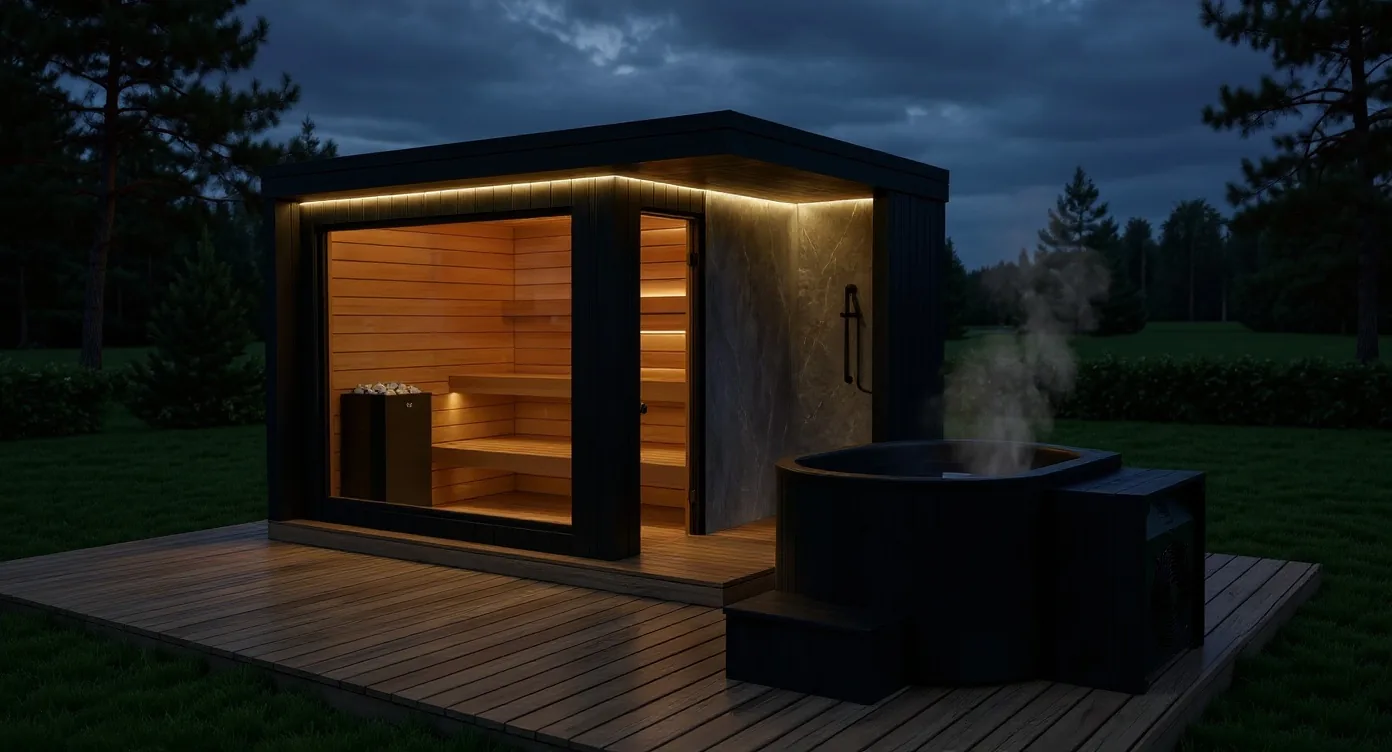
Contrast therapy is a systemic oscillation between heat (sauna) and cold (cold plunge), controlled by intensity and duration. This is not a recent trend — the practice has 2000+ years of documented history in several cultures. What is relatively new is the availability of a controlled cold plunge configuration for private use — KUBIQ is part of that broader trend of moving the practice from public wellness centres into private outdoor spaces.
This article assumes that → Sauna ritual has already been read. There, cold plunge is mentioned as an option for cooling between sessions in the standard ritual. Here, cold plunge is treated as a primary element in a separate practice — contrast therapy is not a ritual in which cold plunge happens, but a practice shaped around cyclical hot-cold exposure as the central event.
What the article does NOT try to be: a medical treatment, a “biohacking” reference, or a list of 10 cold plunge benefits. The approach is technical, physiological and safety-based. Cold plunge has real risks that must be understood before systematic practice.
Step 01What contrast therapy is
Contrast therapy is cyclical exposure to extreme thermal differences. The body goes through an oscillation: heat → cold → rest → repeat. The temperature difference between the two extremes (Δ between a sauna at 85°C and a cold plunge at 5°C is 80°C) is greater than anything the body experiences in natural conditions.
Different traditions that shaped modern practice:
- Nordic tradition — sauna followed by a jump into snow or an icy lake, documented for 1000+ years in Finland, Sweden, Norway, Estonia
- Russian tradition — banya (steam sauna) followed by icy water or snow, a cultural classic
- Japanese tradition — onsen or sento followed by cold water, part of the broader wellness concept
- Wim Hof method — popularized in the 2010s, focused on cold exposure and controlled breathing
- Sports contrast hydrotherapy — clinical protocols for recovery of professional athletes, developed since the 1980s
Important distinction: an “ice bath” is a one-way practice (only cold exposure). “Contrast therapy” is oscillatory (hot-cold-hot-cold). Different practices, different physiological goals, different safety profiles. This article primarily covers contrast — standalone cold practice is covered in §7.
Step 02Physiology — what happens in the body
The physiological response to contrast therapy is well documented in medical literature.
Vasodilation (heat). In the sauna, blood vessels expand, heart rate rises (up to 120–130 bpm), peripheral blood flow intensifies, sweating activates thermoregulation.
Vasoconstriction (cold). In the cold plunge, blood vessels rapidly constrict, blood returns to the core (protection of vital organs), and heart rate gradually falls after the initial shock.
Oscillation = training of the vascular system. Repeated expansion and contraction of the vascular network builds “flexibility” of vascular reactions. In regular users, reduced systemic blood pressure and improved endothelial function have been documented.
Norepinephrine spike. Cold exposure causes a documented increase in norepinephrine 2 to 3 times above baseline. Norepinephrine is a neurotransmitter linked with attention, focus and mood. The subjective effect of a “clearer head” after cold plunge has a neurochemical basis.
Brown adipose tissue. Cold activates brown adipose tissue (BAT), which burns energy for thermogenesis. The effect is real but limited — the amount of BAT in adults is small, and the clinical significance for weight loss is minor.
Vagal tone. After cold exposure, the parasympathetic branch of the autonomic nervous system is activated, which leads to recovery dominance, calming and a drop of heart rate below baseline.
Heat shock proteins + cold shock proteins. Both systems of cellular adaptation are activated through the cycle. HSPs protect cells from thermal stress, CSPs (especially RBM3) support cellular integrity in cold conditions.
Dopaminergic response. Studies document an increase of dopamine baseline up to 2.5x for 1+ hour after cold exposure. Subjectively: a long-lasting feeling of satisfaction and focus.
What is NOT proven:
- Rapid weight loss — the thermogenic effect of cold exposure is real but clinically insignificant for changing body mass
- “Flushing out toxins” — again, kidneys and liver
- Treatment of specific diseases — contrast therapy is a wellness tool, not a medical treatment
Step 03Typical contrast therapy cycle
Difference from the standard sauna ritual from topic 1: cold plunge is the primary element of the cycle, not an option for cooling.
Standard protocol:
- Sauna 10–15 min — Finnish is optimal for contrast (largest temperature Δ); BIO and IR give a weaker effect
- Cold plunge 30s–3 min — time increases with user adaptation
- Rest 5–10 min at room temperature — heart rate returns to baseline, breathing calms
- Repeat 2–3 times
- Final rest 15–20 min — hydration, gradual return to the daily rhythm
Total duration: 60–90 min for a full contrast ritual.
Weekly distribution: maximum 2–3 contrast sessions per week. More does not bring additional benefit — the cardiovascular system needs recovery time. A weekly rhythm with a lot of contrast practice without recovery days leads to chronic stress, not adaptation.
Difference in contrast by sauna mode:
- Finnish (85°C) + cold plunge (5°C) = Δ 80°C → maximum effect
- BIO (55°C) + cold plunge (5°C) = Δ 50°C → moderate
- IR (50°C) + cold plunge (5°C) = Δ 45°C → weaker
Finnish + cold plunge is the optimal combination. Other modes work, but less effectively.
Søberg principle — optional advanced protocol. Research by Dr. Susanna Søberg (Univ. Copenhagen) suggests that ending the cycle with cold, not heat, maximizes BAT activation and dopaminergic response. In practice this means: the last cycle ends with a cold plunge, and the body then warm ups naturally through shivering instead of entering warmth (shower, sauna, blanket). Søberg recommends at least 11 min of total cold exposure per week for metabolic adaptation.
This is an advanced variant — I do not recommend it to beginners because ending cold requires built tolerance and a safe environment for shivering (dry towel, calm position). The standard protocol with a warm finish is the safer entry point.
Step 04Cold plunge technique
Preparation. The body is first heated in the sauna. Never cold plunge without previous sauna for an untrained user — thermal shock without previous vasodilation causes an aggressive cardiovascular response that the organism is not prepared to absorb.
Approaching the water:
- Gradually (for beginners): legs → hips → shoulders → neck. The body has a few seconds to adapt at each phase
- Quickly (advanced): whole body to the shoulders in one movement. More intense cold shock, but it passes through the hardest part faster
Breath — the most important element of technique:
- First 15–30 seconds: controlled breathing, resistance to the cold shock reflex. Cold shock automatically causes a reflex inhale (gasp) and hyperventilation — breath control is the main tool for managing that response
- After adaptation: slow, regular rhythm. Exhale longer than inhale (for example inhale 4s, exhale 6–8s) — activates parasympathetic adaptation
- Wim Hof breathing before entry — optional, not for everyone. Hyperventilation before cold plunge can help adaptation for some, while in others it causes dizziness and insecurity when entering
Position in the water:
- Whole body to the shoulders, back supported if the configuration allows
- Neck out of the water — protection from cold-related cardiac stress
- Head completely dry — vagal reflex on contact of cold water with the face/neck can cause bradycardia or, in rare cases, syncope
- Hands up on the edge of the tub if the user is not comfortable — it gives a safe point of return
Mental approach. Cold plunge is 80% mental practice. The first minute is the hardest — after it the body adapts and discomfort decreases. Focus on the breath, not on the discomfort. Subjective perception of time in cold plunge is distorted (“30 seconds feel like 3 minutes”) — calibrate with a timer the first few times.
Exit:
- Gradual, not sudden — caution because of orthostatic hypotension
- Dry towel immediately, gradual warming
- Not immediately back into the sauna — rest 5–10 min at room temperature is part of the cycle, not a break
- If returning to the sauna for a second cycle, wait until heart rate drops to 80–90 bpm
Step 05Temperature ranges and intensities
Beginner: 10–15°C, 30–60 seconds. Adaptation to the cold shock response, building tolerance. First 2–4 weeks of practice.
Intermediate: 6–10°C, 1–2 minutes. Deepening the effect, normal home wellness range. Most regular users stay here.
Advanced: 3–6°C, 1–3 minutes. Maximum contrast effect. Not over 3 minutes for an untrained user. Requires built tolerance through months of practice.
Beyond the limit (below 3°C, more than 3 min): extreme category. Wim Hof competitions, supervised sports clinical protocols. Not for independent wellness practice.
Rule: duration > temperature. For most applications, 2 minutes at 8°C is better than 30 seconds at 3°C. Extending duration is a more efficient progression than lowering temperature — it gives deeper adaptation with less risk.
Practical note: the subjective experience of cold plunge also depends on the surrounding temperature. Cold plunge at 8°C in a 35°C summer atmosphere feels different from the same 8°C in a 5°C winter environment. Seasonal calibration is real.
KUBIQ cold plunge configuration covers all ranges through the chiller system. → §8
Step 06Safety — extensive
Cold exposure has real physical risks that differ from the risks of classic sauna practice.
Absolute contraindications without medical advice:
- Arrhythmias, especially atrial fibrillation
- Coronary artery disease
- Recent myocardial infarction (less than 6 months)
- Severe uncontrolled hypertension
- Cardiac pacemaker (specific advice from a cardiologist, not only a general practitioner)
- Severe peripheral vascular disease
- Raynaud syndrome (relative contraindication)
- Acute pregnancy — all trimesters
Cold shock response. The first 30 seconds in 5°C water trigger reflex inhale, sudden tachycardia and increased blood pressure. For healthy adults this is manageable and passes. For a compromised heart — potentially lethal. Most cardiac incidents in cold water immersion situations happen in the first 60 seconds.
Hypothermia risk. More than 3 to 5 minutes in 3 to 5°C water triggers hypothermic cascades. Body temperature drops below 35°C, cognitive functions degrade, motor responses slow down. Subjective perception of time is distorted — a user may think they have been in the water 2 minutes when it is actually 5+. A timer is mandatory for sessions below 8°C, exit by the clock, not by feeling.
Alcohol + cold plunge = absolute contraindication. Vasodilation from alcohol + hypothermia risk + reduced judgment + reduced perception of one's own condition. The most dangerous combination in the entire sauna practice package. More cold plunge fatalities in global literature are connected with alcohol than with any other cause.
Diabetes with autonomic neuropathy. Reduced temperature perception means risk of excessive exposure without warning. Endocrinologist advice before contrast practice.
General safety rules:
- Never alone for the first few sessions. Another person present, not necessarily in the water
- Never cold plunge without previous sauna for an untrained user
- Never sudden direct cold water on the face or neck — vagal reflex can cause bradycardia and syncope
- Timer mandatory for sessions below 8°C — subjective perception of time is not reliable in cold water
- Gradual introduction — start with 30 seconds at 10°C, increase over weeks, not days
- Listen to signals — dizziness, strong uncontrolled tremor, difficult breathing, disorientation mean “exit now”
Step 07Cold plunge as standalone practice
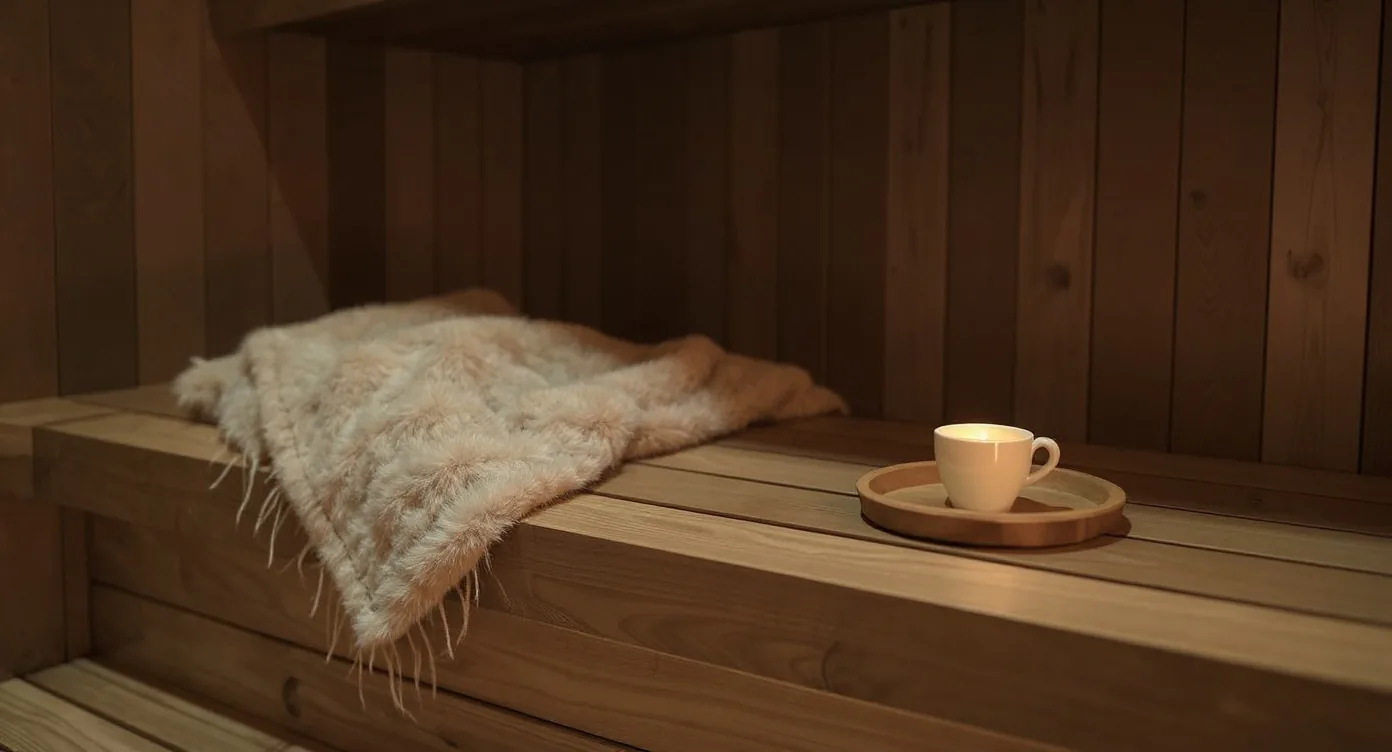
Cold plunge can also be used independently — without previous sauna. This is the Wim Hof method approach and standard in sports recovery practice.
Difference in protocol:
- No previous heating — the body is not in vasodilation, entry is different
- Shorter sessions (30 seconds to 1 minute for most users)
- Lower intensity (8–12°C instead of 3–6°C)
- Focus on breath before and during — Wim Hof breathing is the central component of this variant
Physiological effects:
- Cold shock response (as in contrast)
- Norepinephrine spike (as in contrast, possibly greater because there is no “buffer” of a heated body)
- Dopaminergic response (as in contrast)
- No oscillation — no stress-recovery cycle, only cold stress-adaptation
- Vagal tone activates afterwards, but less strongly than in contrast
Who it suits:
- Athletes after training (classic sports recovery application)
- People with limited time (3–5 min total vs. 60–90 min for contrast)
- Those who want cold practice but do not have a sauna
Safety profile: similar to contrast therapy, but without the “buffer” zone of a heated body. All limitations from §6 still apply.
KUBIQ cold plunge configuration supports both scenarios — it can be used independently without sauna integration, although the integrated variant is a more functional and aesthetically better solution for most users.
Step 08KUBIQ cold plunge configuration and next step
KUBIQ cold plunge is not a catalogue product, but a configuration adapted to the space and other wellness elements on site.
Technical specifications:
- Temperature range: 3–12°C, controlled by chiller system with ±1°C precision
- Filtration: UV sterilization + standard filters (microparticulate and carbon)
- Materials: stainless steel or thermal wood exterior cladding (visual continuity with the wooden sauna)
- Sizes: from compact (1 m³, 1 person) to bespoke larger units (3+ m³, 2–3 people)
- Integration with sauna: shared terrace, planned route sauna → rest → cold plunge → rest
Cold plunge naturally belongs to the Studio line — bespoke integration with sauna, terrace and surrounding space. Standard configurations are also available on kubiq.eu for simpler setups.
→ How to choose the right sauna and wellness configuration
Thinking about cold plunge integration?
Cold plunge is a premium addition that is best executed as part of an integrated outdoor wellness space — sauna, cold plunge, terrace, pavilion in one unified whole.
- studio.kubiq.eu — bespoke wellness integration with cold plunge configuration
- kubiq.eu — standard models and configurations
The configuration conversation starts from the space and intent, not from a catalogue.