
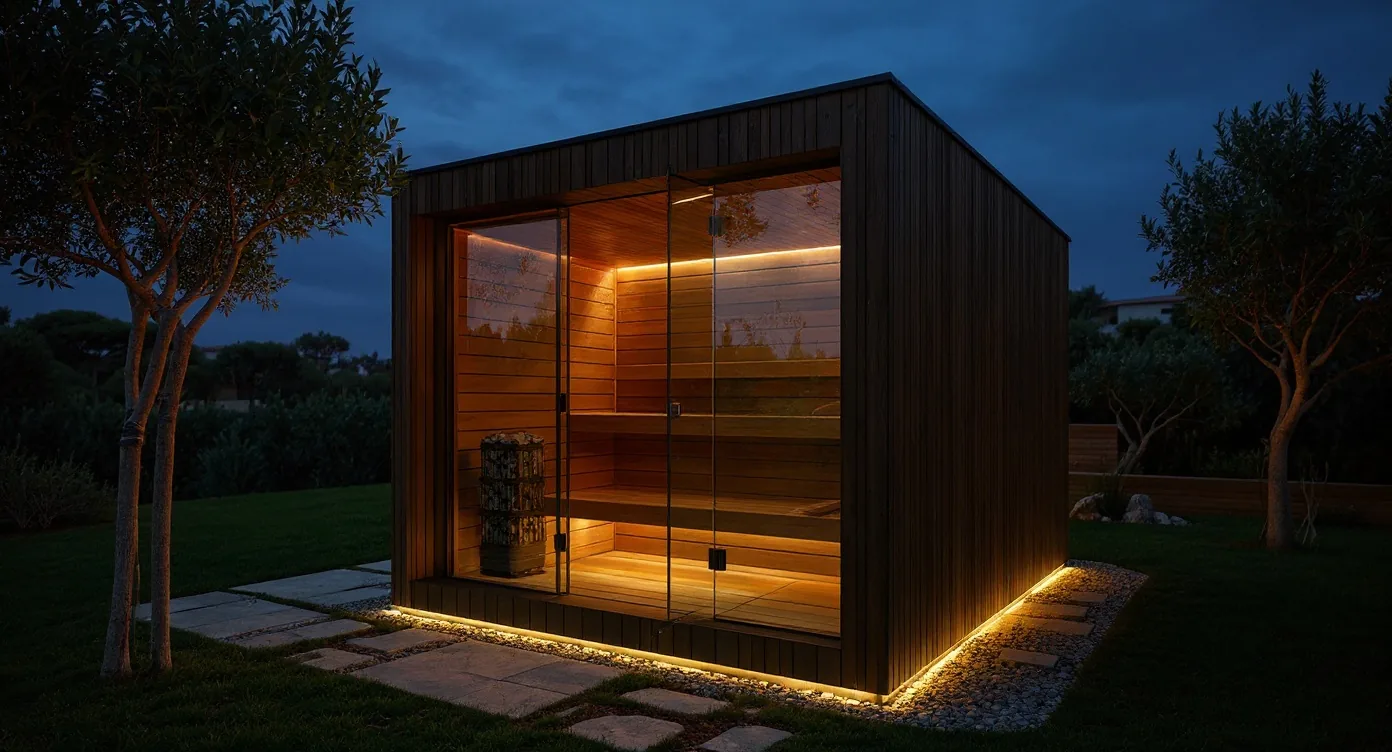
The difference between "going into a sauna" and "a sauna ritual" is the difference between contact with heat and the physical reset cycle that occurs when the temperature oscillation completes a full loop: heating, peak, cooling, rest. The body responds to each phase with a different mechanism — vasodilation, contraction, recovery, adaptation. Any phase skipped cancels part of the effect.
This guide walks through the five-phase protocol used by someone who practises the sauna ritual as a weekly routine, not an occasional experience. It assumes a sauna supporting the classic Finnish configuration with stones — the baseline mode of KUBIQ saunas. Versions for infrared, BIO, and contrast therapy are covered in separate articles.
A sauna ritual, properly done, takes between 60 and 90 minutes. No shorter. The rest is improvisation.
Step 01What a sauna ritual is — historical foundation
The word "sauna" is Finnish in origin and, in its original meaning, refers not to a space but to a state. The Finnish concept of löyly — the steam created when water is poured over hot stones — was described as the "spirit of the sauna," an entity in the room whose presence changes with every pouring. Traditionally, one entered a sauna with a measure of respect for a sacred space.
In Finland today, there are more saunas than cars — around 3.3 million saunas for 5.5 million inhabitants. For generations, the sauna has been a weekly hygienic, physiological, and social practice — not a luxury.
The essential distinction: ritual ≠ activity. The activity is "step into a sauna for 20 minutes and leave." The ritual is a structured process with phases, timings, and rules that exist for a reason — a physiological one.
One complete sauna cycle triggers a sequence of bodily responses: vasodilation (blood vessels expand, sweating drives thermoregulation), peak thermal stress (short, controlled — activates the heat shock protein response), vasoconstriction (cooling — blood returns to the core; this contrast is where the "reset" happens, not in the sauna itself), and recovery (rest — the autonomic nervous system shifts into parasympathetic dominance, heart rate drops below baseline).
Skip the cooling or rest and you've captured 40% of the effect. Run all phases but only once and you have 60%. A proper cycle requires 2 to 3 full passes. This is not esoterica — this is thermoregulation.
Step 02Anatomy of the cycle — 5 phases
Timings are indicative — adapt them to your own tolerance, but the order does not change.
Phase 1: Preparation (30–60 min)
Heating the sauna. Do not enter until the stones have reached full thermal capacity. Electric stoves with a thin stone layer (HUUM, SIOP) reach operating temperature in 30–45 minutes. Soapstone stoves (Tulikivi) require 60–90 minutes because they accumulate heat in the stone mass — but in return, they hold temperature longer and deliver softer steam. Entering too early means a sauna that does not support the löyly.
Body. 0.5 litres of water 30 min before entering. Shower with soap 5 min before — cosmetics, creams, and dry sweat aerosolise at 80 °C. After showering, dry the body completely — damp skin delays sweating and cools the body outside the protocol. Remove all metal items (watches, chains, glasses) — they absorb heat and can cause burns.
Avoid 1–2 h before: a heavy meal (digestion pulls blood from the periphery), alcohol in any amount, intense cardio, large doses of caffeine.
What to wear. Two towels (one to sit on, also covering the feet; one for drying), a bottle of room-temperature water. The Nordic standard is bare skin with a towel underneath; if a swimsuit is required — cotton or linen, clean, sauna-only. Synthetic fabric releases chemicals at 80 °C and does not breathe.
Phase 2: Sauna session (10–15 min)
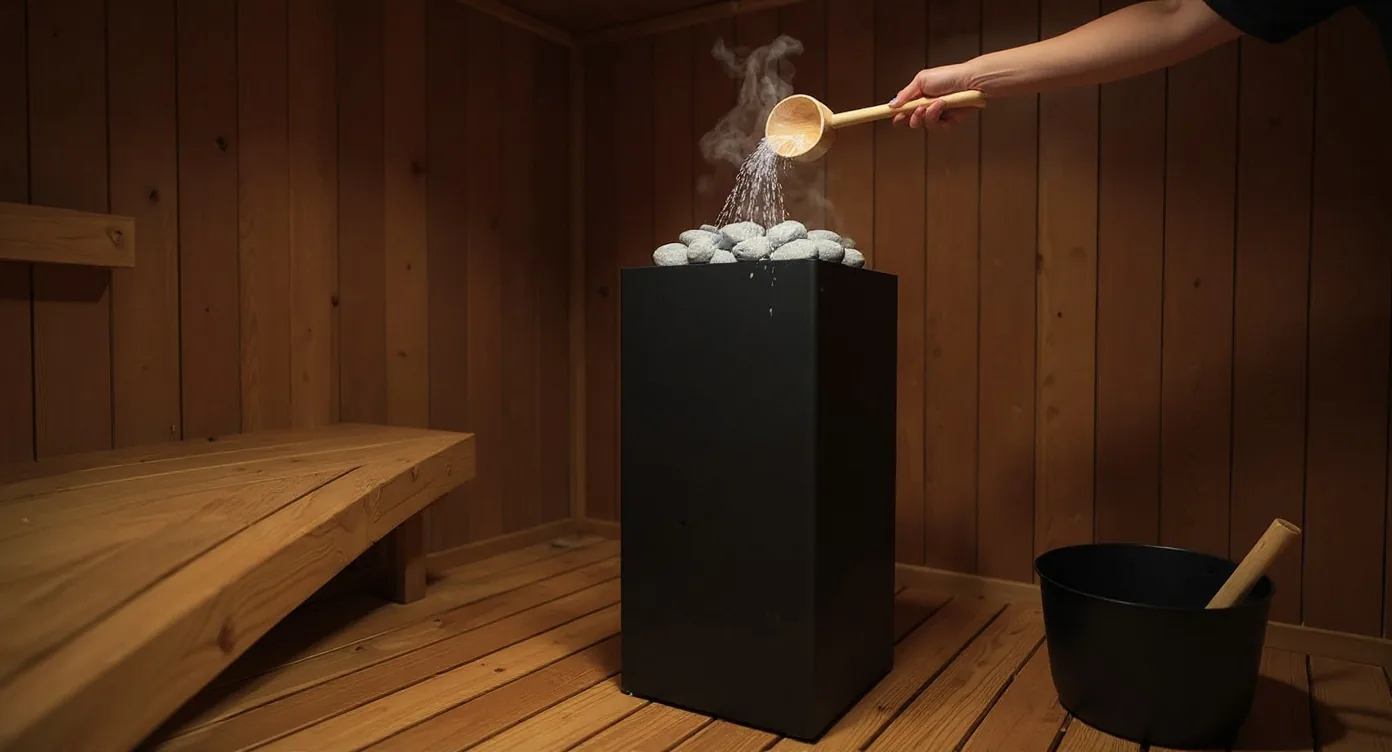
Sit on the upper bench (the hot zone), not the lower — the temperature difference between levels can be as much as 20 °C. Avoid pouring water for the first 5 minutes to let the body acclimatise to the air.
Löyly technique. 1 to 2 decilitres of water per pour, every 3–5 minutes as desired. Over-pouring does not create more löyly — it creates condensing steam that falls back down and makes the sauna wet rather than steamy. A disciplined hand is the mark of an experienced user.
Water at room temperature or warm — never ice-cold. The thermal shock when ice-cold water contacts stones at 350 °C causes microcracks; on soapstone, it can cause fracturing. KUBIQ saunas come with an integrated wooden vessel that keeps water at 30–40 °C.
Essential oils. 1–2 drops diluted in the ladle, never directly on the stone — direct contact with stone at 300 °C+ ignites oil vapours (a safety problem, not a stylistic one). Classics: eucalyptus (winter), birch (Finnish standard), pine/spruce, lavender (evening ritual), mint (summer).
Verticalisation. The last 2 minutes are spent sitting upright, not lying down. The circulatory system adapts to a vertical position before exit — without this, leaving the sauna can cause dizziness or orthostatic hypotension.
Phase 3: Cooling (5–10 min)
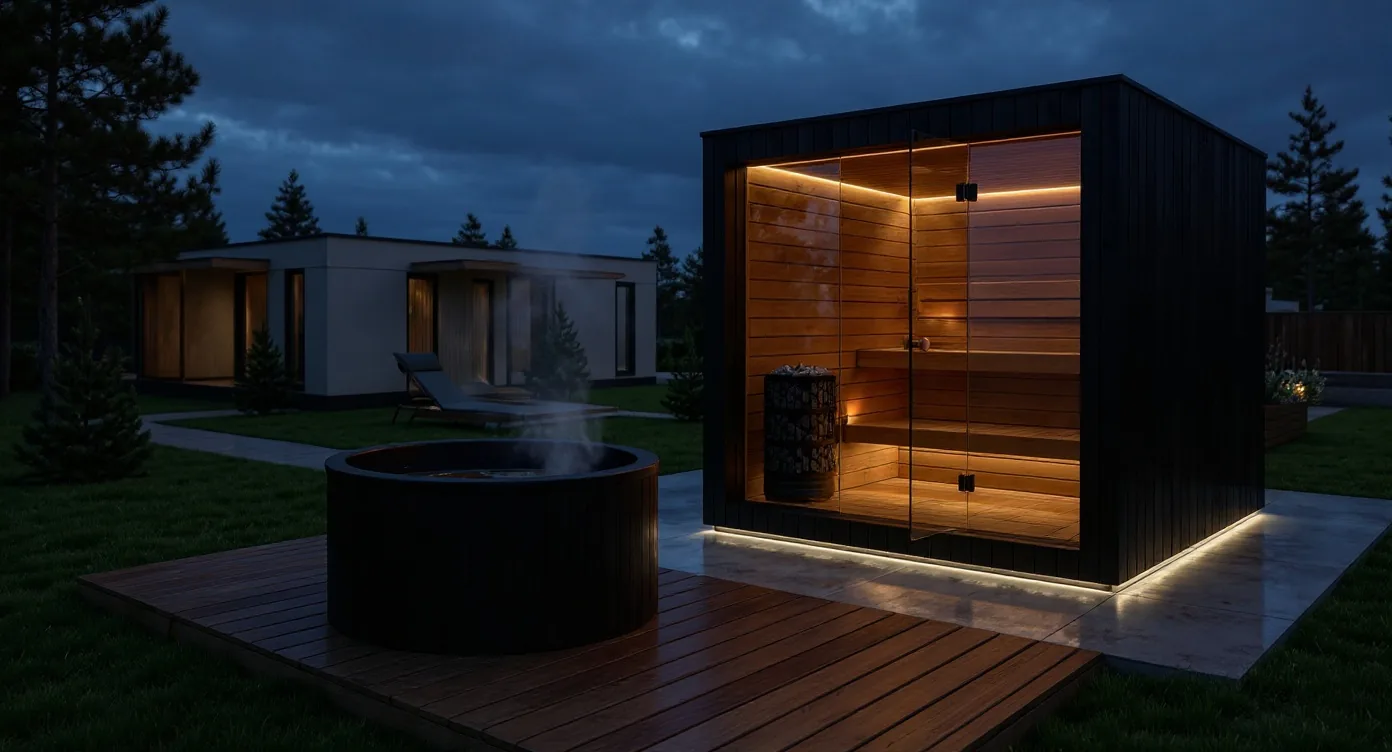
Cooling is not a pause but half of the cycle. When the body steps out of an 80 °C environment into a 15 °C shower or a 5 °C cold plunge, sudden vasoconstriction occurs. This oscillation — expansion then contraction — is what gives the sauna ritual its cardiovascular effect. Without cooling, the sauna is just "being in the heat."
Order: first, a minute of fresh air breathing deeply (cooling the airways), then a shower from the periphery toward the heart (feet and hands first, gradually toward the torso — cold water directly on the head and neck can trigger a vagal reflex), then optionally a cold plunge.
Three methods by intensity:
- Lukewarm to cold shower (1–3 min) — accessible to everyone, delivers 80% of the effect
- Fresh air (3–10 min) — particularly effective in winter; stepping out into 0 °C air is a sharper contrast than a 15 °C shower
- Cold plunge (30 s – 3 min, 3–12 °C) — maximum contrast; beginners 6–12 °C for 30–60 s, advanced 3–6 °C for 1–3 min → Full guide: Contrast therapy and cold plunge
Cold plunge after alcohol — an absolute contraindication.
Phase 4: Rest (10–15 min)
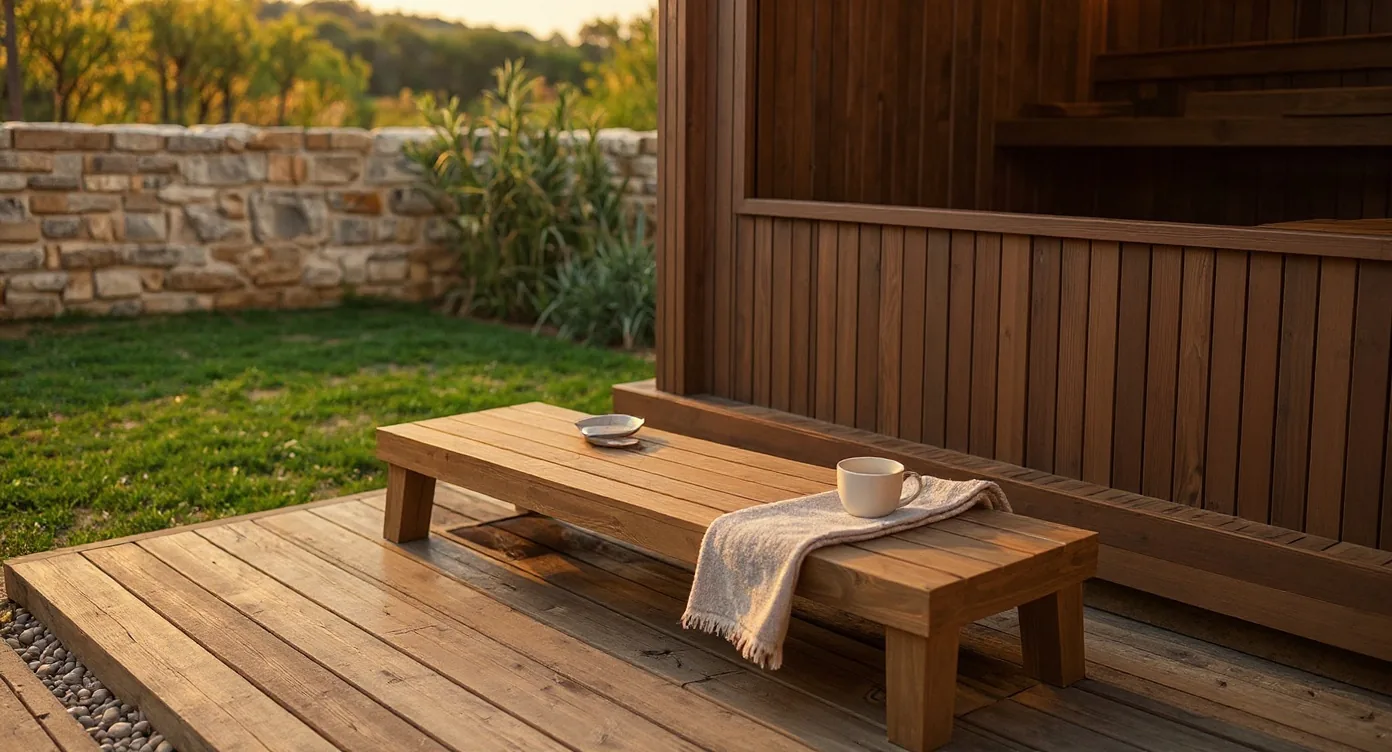
The phase where actual homeostasis occurs. The autonomic nervous system shifts into parasympathetic dominance — this is where the "reset" happens. Without rest, the next cycle is just a repetition of thermal stress.
Sit or lie down on a dry surface, drink 200–300 ml of water, breathe quietly. No phone if possible. Duration rule: rest lasts at least as long as the session, ideally longer.
Phase 5: Repetition (2–3 cycles)
The second session is technically more pleasant than the first — tolerance builds, the löyly is more intense, and you move from "enduring the heat" to a state of focused presence. The third session is optional and typically the quietest. More than three cycles rarely brings additional benefits and may cause dehydration.
Finish. Lukewarm shower (not cold), dry off, 15–30 min of rest before stepping out into cooler air or going to bed. The body continues to sweat for 30+ minutes after the last session — 0.5 l of water and 1–2 dl of electrolytes (coconut water, lightly salted water) are standard.
Total duration: 75–110 min for a 3-cycle ritual, 60–75 min for a 2-cycle. Less than 60 min is not a sauna ritual — it's a warm entry.
Step 03Temperature by mode
The three standard modes have different optimal ranges:
- Finnish sauna — 75 to 90 °C, humidity 5–20% (via löyly), sessions 10–15 min. The reference mode for this guide. → Finnish sauna — full guide
- BIO sauna (soft sauna) — 45 to 60 °C, humidity 40–65%, sessions 30–45 min. A hybrid of Finnish and steam bath; gentler on circulation, easier for sensitive users. Available only on Combi stoves. → BIO sauna — full guide
- Infrared sauna — 35 to 65 °C air; the body is heated by radiation, without stones. Sessions 20–30 min, lower cardiovascular stress, focus on local recovery. → Infrared sauna — full guide
Modes are not combined within the same session — different physics, different responses. → Combining modes
Step 04Seven common mistakes
Mistakes that systematically neutralise sauna benefits. Each sounds reasonable in its own context — which is why they recur.
1. Alcohol before or during the sauna. Alcohol and sauna are both vasodilators. The combination drops blood pressure too quickly, causes orthostatic hypotension, and in extreme cases syncope — which in a room with an 80 °C stove is not benign. A beer on the terrace afterwards is fine. Before or during — an absolute contraindication.
2. Too long in a single session. More than 20 minutes is not a "more intense ritual" — it's thermal stress without a recovery phase. Optimum: 10–15 min × 2–3 cycles, not 45 min × 1.
3. Skipping the cooling. "A quick shower and back in" is not cooling — it's sweating-through-an-interruption.
4. A heavy meal 1 h beforehand. The blood pulled by digestion into the abdominal organs is not available for thermoregulation. A light meal 2 h+ before, nothing substantial in the final 60 minutes.
5. Intense cardio an hour before the sauna. Tachycardia + 80 °C = a potentially dangerous combination. A sauna after exercise is good practice, but with a 60+ min gap and hydration in between.
6. Pouring ice-cold water on the stones. Microcracks, accelerated ageing. Particularly damaging to soapstone (Tulikivi) stoves.
7. Sauna during acute illness or fever. "I'll sauna to sweat out the cold" is a myth. The body is already under thermal stress — additional load makes it worse.
Step 05Weekly rhythm — how often
- Beginners (first 4–6 weeks): 1–2 times per week. The goal is thermoregulatory adaptation, not intensity
- Regular users: 2–4 times per week — optimal for most
- Recovery / athletic profile: 4–5 times per week, more often shorter sessions with emphasis on contrast therapy
Signs it's too much: fatigue after the sauna (the ritual should leave one calm, not depleted), headache the following morning, disrupted sleep, drop in training performance.
Best time of day: evening ritual (19:00–21:00) for relaxation — finish at least 2 h before sleep; morning ritual for focus — short, 1 cycle, strong contrast; afternoon (15:00–17:00) for post-training recovery.