
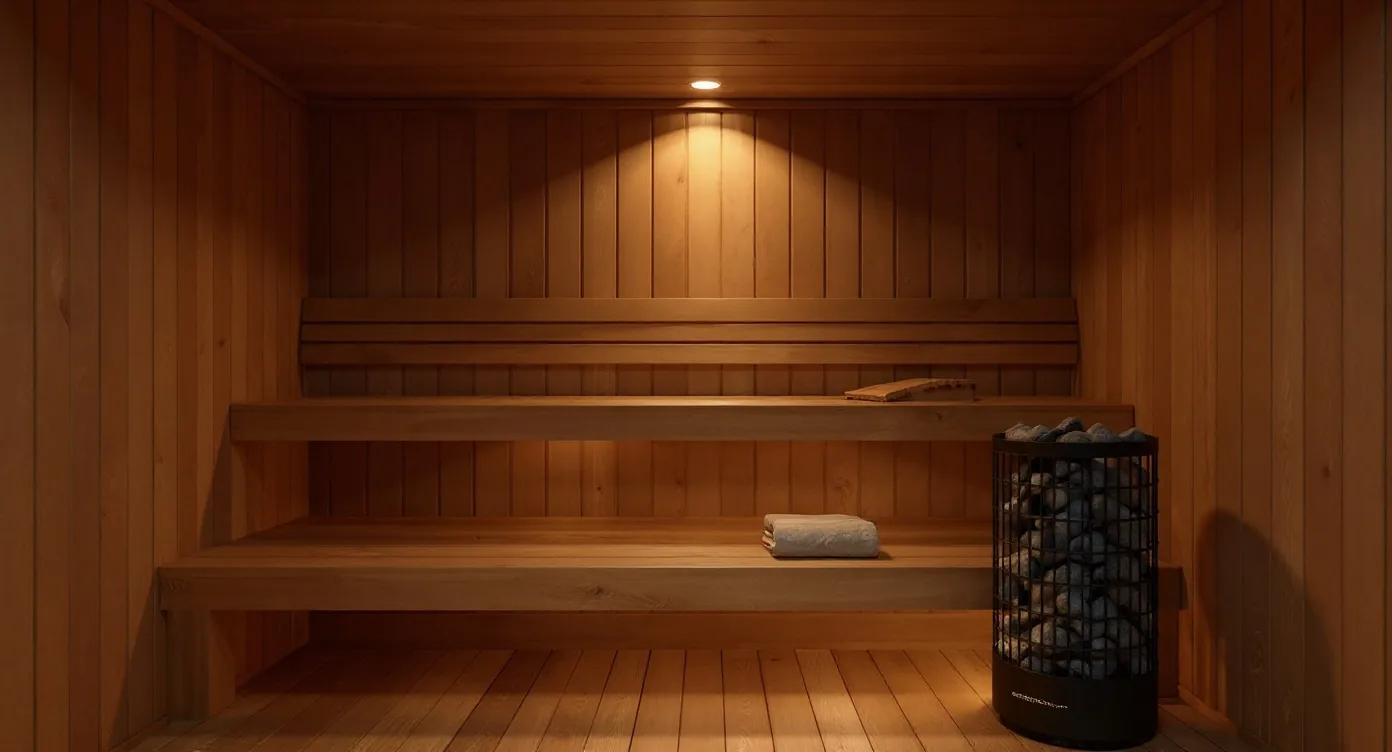
The Finnish sauna is the reference mode around which all modern sauna culture has been shaped. Its defining feature is not only temperature — 75 to 90°C — but a specific combination of physics (dry baseline air interrupted by occasional waves of steam), architecture (stones, benches on several levels, controlled ventilation) and approach (löyly as the central gesture of the session).
This article assumes that → Sauna ritual has already been read. The general protocol of cycles, cooling and rest is covered there and is not repeated here. Here the focus is on the Finnish specifics: what makes this mode, how to use it correctly, why the benches are arranged with purpose, how löyly is graduated and which safety points are specific to high temperatures.
Step 01What defines the Finnish sauna — physics and character
Three variables define the Finnish sauna: temperature, humidity and heat source.
Temperature: 75 to 90°C. Below 75°C it does not deliver the full thermal stress that is the purpose of the mode — the session becomes passive sweating. Above 90°C it moves outside the healthy operating zone and is not suitable for everyday use.
Humidity: 5 to 20%. Low, deliberately. Low baseline humidity makes high temperatures tolerable — the same 80°C air at 80% humidity would be physiologically extreme. Dry air acts as a thermal insulator, sweating is immediate and abundant. Humidity is temporarily raised through löyly and then gradually drops back to baseline.
Heat source: heater with stones. This is not a stylistic decision. Stones accumulate thermal energy, transfer it to the air by convection and make löyly possible. A sauna without stones — regardless of temperature — is not a Finnish sauna. It is a heated chamber.
The character that results from these three variables is bipolar: during the session, periods of dry high-energy air alternate with short waves of steam. The body responds to each wave with intensified sweating and an increase in perceived temperature of 10–15°C, even though the actual air temperature drops slightly. Between waves the air returns to baseline, sweating stabilizes, breathing becomes more regular. This oscillation — not temperature alone — is the signature of the Finnish mode.
Step 02Technical anatomy — what a Finnish sauna must have
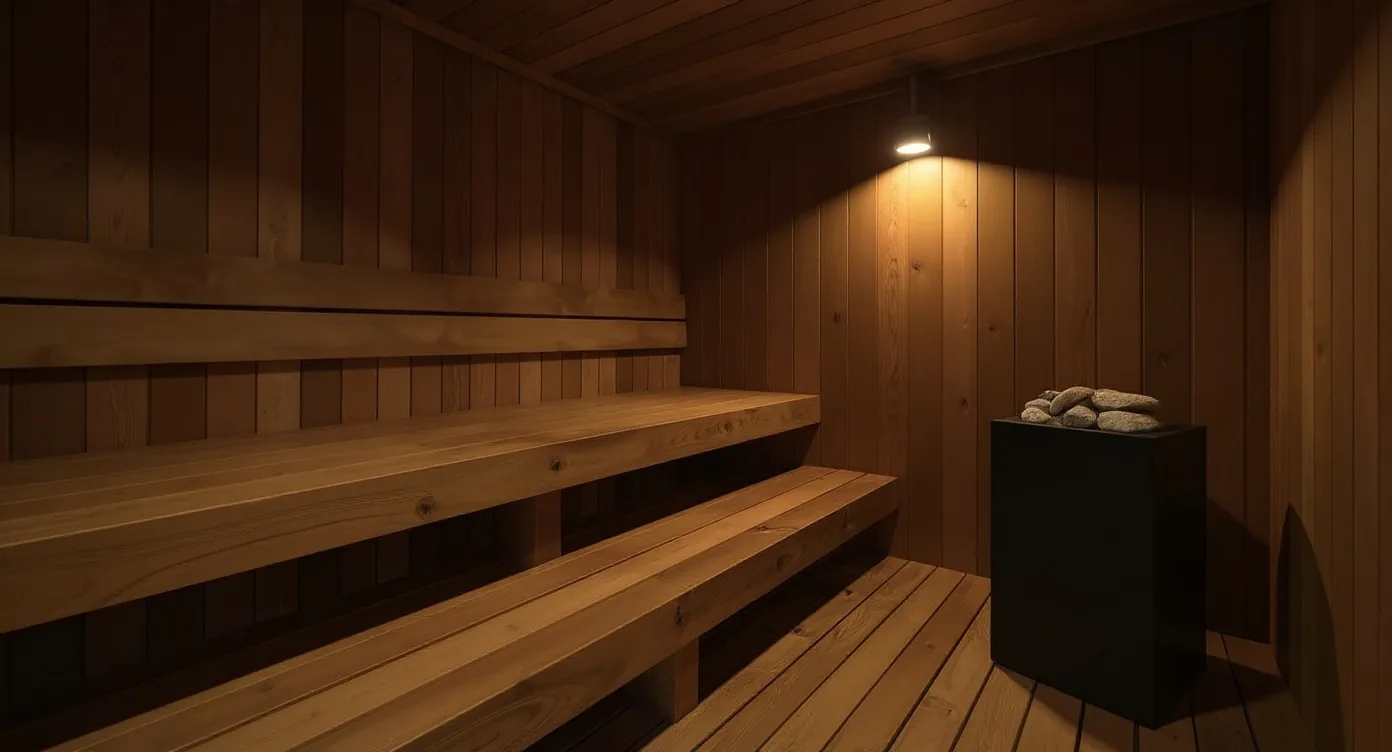
A functional Finnish sauna has five key elements. The absence of any one of them degrades the mode into something that resembles a Finnish sauna, but does not operate as one.
Heater and stones. Electric heaters with stones (HUUM CORE, SIOP ecoReg) heat the stones to 300–400°C. Soapstone heaters (Tulikivi) have greater thermal mass — they heat up more slowly (60–90 min vs. 30–45 min), but hold a stable temperature and produce softer steam. The type of stones affects the character of löyly: olivine (KUBIQ standard) gives fast, intense waves; soapstone gives the softest ones.
Benches on several levels. A Finnish sauna is not a flat space. The temperature difference between the lower and upper bench is 30–40°C (lower ~55°C, upper ~85°C). This is a feature, not a fault — the user moves according to the phase of the session and tolerance. A sauna with a single bench level is not a full Finnish sauna.
Ventilation. Fresh air intake under the heater, outlet high on the opposite side. It circulates the air, keeps oxygen in the breathing zone and ensures that löyly does not remain trapped under the ceiling. Poor ventilation means difficult breathing, a rapid drop in air quality and headache after the session.
Interior material. Thermo alder, abachi and thermo cedar have low thermal conductivity — at 80°C they do not cause local burns on touch, which ordinary pine or spruce can do. Thermal stabilization (the Lunawood process) additionally reduces resin exudation.
Room size. Finnish tradition insists on compactness. Too small (below 4 m²) becomes claustrophobic. Too large (above 8 m²) does not hold a stable temperature. The optimum for 2–4 people: 5–6 m².
Step 03Who the Finnish sauna suits — and who it does not
It suits especially:
- Athletes and active users — high heat penetrates muscle fibres, stimulates vasodilation, accelerates the elimination of metabolic by-products and cellular recovery. In combination with contrast therapy it becomes a recovery tool. → Contrast therapy and cold plunge
- Users who want cardiovascular training — heart rate in a Finnish sauna rises to 110–130 bpm, which corresponds to a moderate cardio range, and trains the elasticity of blood vessels
- Those looking for cognitive decompression — high temperatures demand focus on breathing, which reduces background anxiety
- Users who prefer shorter, more intense sessions with breaks rather than long, continuous ones
It does not suit well:
- Unregulated high blood pressure (it should be medically regulated with a doctor’s advice)
- Cardiac diagnoses (coronary disease, arrhythmias) without explicit medical approval
- Acute pregnancy, especially the first trimester
- Low tolerance for high temperatures — this is not “weakness” but individual sensitivity of thermoregulation
The last category is often overlooked. If the body actively rejects 80°C — dizziness after 5 minutes, nausea that does not decrease after 2–3 attempts — BIO sauna is a legitimate alternative, not a compromise. Lower temperature (45–60°C) with controlled medium humidity gives a similar recovery effect with significantly less thermal stress. → BIO sauna
A sauna is not an endurance test. If a mode does not suit the body, another mode exists for a reason.
Step 04Typical protocol — Finnish specifics
The general eight-part cycle is covered in → Sauna ritual. Here we look at the specificity that the Finnish mode requires within that framework.
First session: 8 to 12 minutes. Adaptation. Sitting on the lower or middle bench, not at the top — thermoregulation is not active yet, and entering directly into the 85°C zone is unnecessarily stressful. Pouring water over the stones is delayed for the first 5 minutes.
Second session: 12 to 15 minutes. Main session. The upper bench is now fine — the body is adapted. Pouring starts from minute 5, at a rhythm that suits the user (every 3–5 min). Most people enter a state of focused presence in this session.
Third session: 10 to 15 minutes (optional). Calmer. Less pouring, more passive heating. The function is not additional thermal stress, but deepening parasympathetic adaptation.
Benches as a tool, not decoration. Moving up and down during the session is a legitimate technique. The lower bench is a “soft reset” in the middle of the session if the upper one has become too much. Lying on the upper bench exposes the whole body to the same temperature — worth trying at least once.
Stop criteria are signals, not a clock. Dizziness, nausea, headache, loss of focus or a paradoxical feeling of cold (sweating stops) mean “out immediately”. An experienced user leaves one second before the body asks for it.
Simple protocol
For beginners:
- Heat the sauna to 75–80°C
- Enter for 5–8 minutes, sit on the lower or middle bench
- Near the end, if desired, lightly pour a smaller amount of water over the stones
- Exit, shower with lukewarm or cooler water
- Rest for 10 minutes with water
- Repeat once more if the feeling is good
For more experienced users:
- Heat the sauna to 80–90°C
- First cycle as adaptation (8–12 min), pouring from minute 5
- Second cycle as the main one (12–15 min), controlled löyly technique
- Cooling + rest between each cycle
- Optionally, a third calmer cycle
- Finish when the body says it is enough — not when the clock says there should be more
Step 05Löyly — deep technique
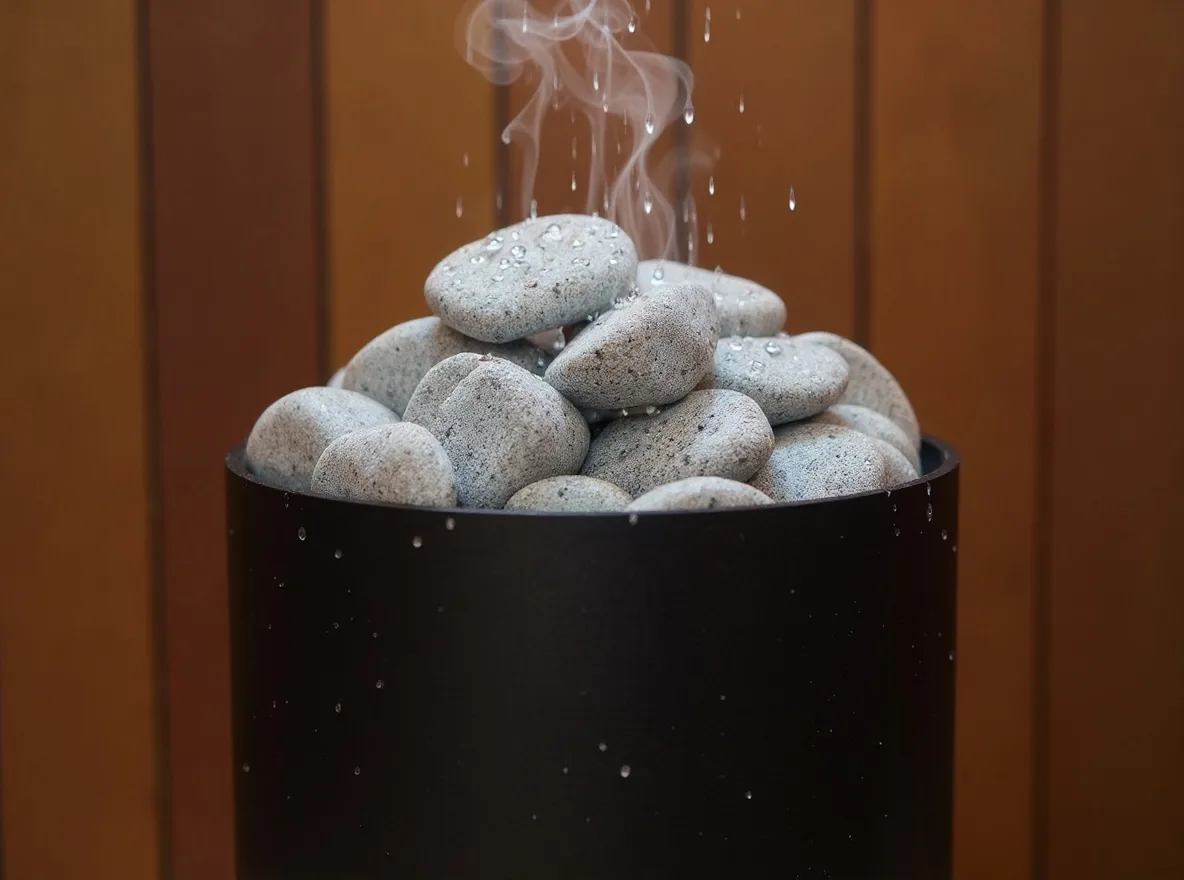
The basics of pouring water are covered in → Sauna ritual. Here we go deeper into what Finnish tradition calls löyly etiquette — the precision that separates a user from a connoisseur.
Layered löyly technique. Three pourings in sequence, gradually increasing: 0.5 dl, then 1 dl, then 1.5 dl. A gap of 30–60 seconds between them. Gradual increase keeps the steam controlled; the body adapts to each wave before the next one. The alternative — one large dose of 3 dl — creates a shock effect that most users cannot tolerate and overloads breathing.
Pouring technique. Evenly over the top of the stones with an arcing movement, not as a splash into one point. Edge stones are always cooler (the heater edges lose more heat to the wall) and produce weaker steam. The centre of the heater is the target area. Never directly onto the heating elements beneath the stones — water on the element shortens its life and can cause cracking.
Seasonal choice of scent. A tradition that survives because it works:
- Winter: eucalyptus (opens the airways), birch (cleansing, Finnish standard)
- Spring: mint, citrus (light, refreshing)
- Summer: pine, spruce (forest-like, intense)
- Autumn: lavender (relaxing)
Dosage: 1–2 drops diluted in a ladle of water, never directly on the stone. Undiluted essential oil on a 300°C+ stone ignites oil vapours and can create toxic by-products.
Vihta (dried birch whisk) — traditional Finnish advanced technique. It is soaked for 10–15 min in warm water, then used to lightly whip the skin for circulation and transfer of birch scent. On the HR/SLO/AT market it is rarely available commercially — mainly from Finland or homemade at the end of June. Tradition, not an obligation.
What NEVER goes into pouring water:
- Alcohol — vapours at high temperature become toxic and flammable
- Sugar, honey, syrups — they caramelize on the stones, damage the heater and leave permanent stains
- Commercial “sauna fragrances” of suspicious origin — they often contain solvent bases that produce toxic vapours
- Disinfectants — stones are not cleaned by pouring water while they are hot
Step 06Differences from other modes
| Feature | Finnish | IR | BIO |
|---|---|---|---|
| Temperature | 75–90 °C | 35–65 °C | 45–60 °C |
| Humidity | Low (dry) + löyly pulses | Very low (dry) | High (40–60 %) |
| Session duration | 10–15 min × 2–3 cycles | 20–30 min once | 15–25 min × 2 cycles |
| Mechanism | Convection through hot air | Direct IR radiation on skin | Convection + steam from vaporizer |
| Sensation | Intense, cardiovascular | Gentle, dry, penetrating | Softer, humid, protective |
| Typical goal | Classic ritual, cardio stress | Recovery, lower intensity | Wellness, stress regulation |
A detailed comparison is covered in → Combining modes. The practical consequence for choosing the mode:
Finnish sauna is performed in shorter sessions with breaks — the protocol is structured (several cycles, cooling between them). Time block: 60–90 min for a full ritual.
BIO and IR are performed in longer continuous sessions without such aggressive cycles — it is possible to stay 30+ min in one session without a necessary exit.
This affects the choice of mode for specific situations:
- Evening ritual with plenty of time → Finnish with three cycles
- Quick recovery session after training → IR sauna 20 min
- Family use with children or older users → BIO sauna 30 min
Step 07Safety specific to the Finnish mode
Specific points that arise from high temperature and are not covered in the general → Sauna ritual:
Rapid rise in heart rate in the first minute. From 70 to 110+ bpm. Enter slowly, not out of breath from running up the stairs. Sit down immediately; do not stand “to get used to it”.
Orthostatic hypotension when exiting. Vasodilation + standing up = drop in blood pressure. Stand up gradually, especially after the third session.
Towel as burn protection. Direct contact between skin and wooden bench at 85°C can cause local burns on more sensitive areas (hip, knee). A towel is not etiquette, but protection.
Head in the 85–90°C zone. When sitting on the upper bench, the head is in the hottest zone. Lowering the head onto a towel or moving down is legitimate if it becomes too much.
Electronics. Phones, smartwatches, headphones — all are damaged at 80°C. Li-ion batteries can explode. They stay outside the sauna.
Step 08Next step
The Finnish sauna is the reference mode, but not the only one. The choice between Finnish, BIO and IR configuration depends on weekly practice, body tolerance and the space in which the sauna is placed.
→ How to choose the right sauna — guide through configurations
Considering your own sauna?
KUBIQ produces outdoor saunas in two tiers:
- kubiq.eu — standard models and configurations
- studio.kubiq.eu — bespoke, integrated wellness solutions
View the models or arrange a consultation — the first step is a conversation, not an offer.