
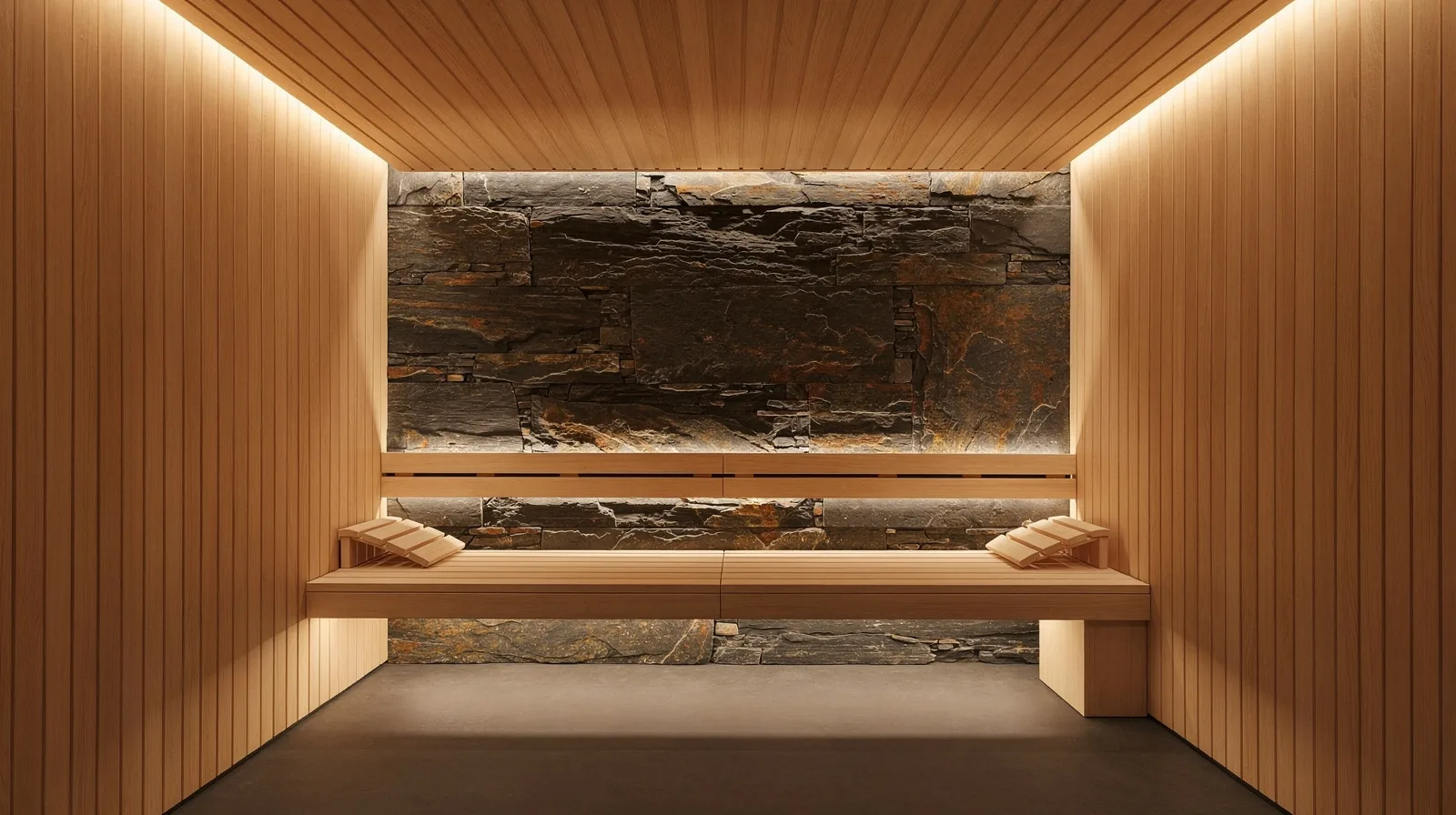
As with exterior materials, KUBIQ does not offer one default look here. There is a spectrum — wood, stone accent, salt — and the choice is composed project by project, according to the tone you want and the way you will use the sauna. This guide explains what that spectrum consists of and what each material brings into the space where you sit.
Step 01Why the interior is not the same decision as the facade
Outside, a material works against rain, UV and frost. Inside, it works against something else: high heat, humidity, sweat and direct contact with skin.
Three criteria that almost do not exist outside, but decide inside:
- Thermal conductivity. A material that heats up too much burns the skin on contact. That is why benches and backrests require low-conductivity wood — it remains comfortable even when the sauna air is very hot.
- Resin and chemistry. Resinous wood creates hot resin pockets and a smell you do not want in a closed hot space. A sauna interior requires resin-free wood.
- Behaviour with humidity. Dimensional stability and resistance to humidity and bacteria preserve both appearance and hygiene over the years.
Appearance still matters — but it comes after these criteria, not before them.
Step 02Wood for cladding: the spectrum
Wood is the foundation of every sauna interior. Species differ in tone, brightness and how they behave over time. KUBIQ typically offers the following spectrum:
- Aspen — very light, almost white tone, soft and uniform. Classic Scandinavian appearance, neutral and calm. Low thermal conductivity.
- Alder — warmer, slightly reddish-brown tone. It makes the sauna feel warmer and softer to the eye than aspen.
- Thermo-aspen — aspen that has undergone thermal modification: darker, warmer tone and greater dimensional stability while retaining a lighter character.
- Thermo-alder — thermally modified alder: rich, dark, warm tone. A premium choice for a sauna that feels wrapped and intimate from the inside.
- Hemlock — light to medium-light, with a very uniform texture and without pronounced knots. Clean, calm appearance.
- Lunawood — Nordic thermally modified wood, brown tone, resin-free, low thermal conductivity and highly dimensionally stable. Covered in more detail in a separate guide.
Each of these gives the space a different feeling — from light and airy (aspen, hemlock) to dark and enveloped (thermo-alder). This is the first and most important step in setting the tone of the interior.
*On request, we also work with various exclusive materials outside this standard spectrum — when a project calls for something specific.*
Step 03Benches: wood that does not burn and works with the rest
The bench is the place of the longest and most direct contact with skin, so choosing bench wood is its own decision — it does not have to be the same wood as the wall cladding.
For benches, KUBIQ uses aspen and alder, in standard and thermo versions, and the choice depends on the rest of the interior — the bench is tonally aligned with the walls and ceiling into a coherent whole. A darker interior usually calls for a darker bench; a light interior for a light bench.
Abachi is an additional bench option — an African wood with extremely low thermal conductivity, very light and soft, with almost unnoticeable heating to the touch. It is not the default choice, but one of the materials we offer when it fits the project.
What all bench choices have in common: low thermal conductivity, so the surface remains comfortable even when the sauna is at full temperature.
Step 04Accents: when wood is not everything
The interior does not have to be only wood. Part of a wall can become a visual accent that changes the character of the whole space — always in combination with wood, not as its replacement.
- SlateLite — flexible stone panel. A real thin layer of natural stone on a flexible backing. As an accent section of wall inside the sauna, it creates an architectural, monolithic contrast to warm wood — the same material KUBIQ uses outside, here as an interior detail. (Separate guide on SlateLite.)
- Himalayan salt — see the next step.
The logic of the accent is curatorial: the whole interior is not done in stone or salt; one wall or one surface is used to give the space focus and character.
Step 05Himalayan salt: decor and function
Himalayan salt blocks are installed as a decorative part of one wall — a warm amber glow when backlit, a visual focus of the space.
In addition to its decorative role, salt also has an air ionisation function, which is why it is often associated with the wellness experience in a sauna, not only with appearance.
Salt is stable for Finnish and combi BIO saunas and is installed on request — as part of a wall, not as full cladding.
Step 06The heater as the centre
The heater is the functional and visual centre of the sauna. Choosing a heater is a technical topic of its own (output, type — Finnish, BIO, combi), but in the context of the interior one premium appearance option is worth mentioning:
Tulikivi soapstone heater cladding. Soapstone (massive stone) as heater cladding gives a solid, monolithic stone character and soft, long-lasting heat. It is an optional upgrade — a more expensive option for projects that specifically want that look and feeling, not a standard execution.
*(Heater types and the technical choice of heating are covered separately — here we are only looking at how the heater appears in the space.)*
Step 07How KUBIQ composes the interior
The interior is not chosen from a catalogue but according to the project. Three things guide the decision:
- The tone you want — light and airy (aspen, hemlock) or dark and enveloped (thermo-alder)? This sets the basic character.
- Touch and purpose — how intensively and how long you use the sauna, and who uses it. This affects the choice of bench wood.
- Whether you want an accent — whether the interior remains purely wooden, or one wall receives stone or salt as a focus.
Combining is the rule, not the exception: wood as the base, an accent where it makes sense, benches aligned with the whole. If a combination does not work — tonally or in execution — we will say so and suggest a better one.
Step 08What interior choice is not
- It is not only aesthetics. Low-conductivity, resin-free wood is not a matter of taste — it is the difference between a pleasant and unpleasant sauna. Appearance comes after that.
- It is not one default look. As outside, there is no single “KUBIQ interior”. There is a spectrum and a project-specific choice.
- It is not a catalogue you choose from alone. Material is a decision we guide together — tone, touch and the purpose of the sauna determine what makes sense.