
That is normal, and it is exactly why material should not be the first decision.
The exterior material of an outdoor sauna has to do several things at once: withstand sun, rain, frost and UV; keep its character for years; and fit into the space where it stands. A black facade that looks spectacular in a render may not be the right choice for a garden surrounded by greenery and grey stone. A warm honey tone that looks perfect today will grey within two years — and that may be exactly what you want, or exactly what you do not want.
The point of this guide is not to tell you which material is best. It is to show what this decision is based on — so you choose the one that makes sense for your space, not the one that photographed best.
Material is a step in the process, not a field you fill in at the beginning. Through conversation and the context of the space, we narrow the choice together. This guide prepares you for that conversation.
Step 01Four directions, not one look
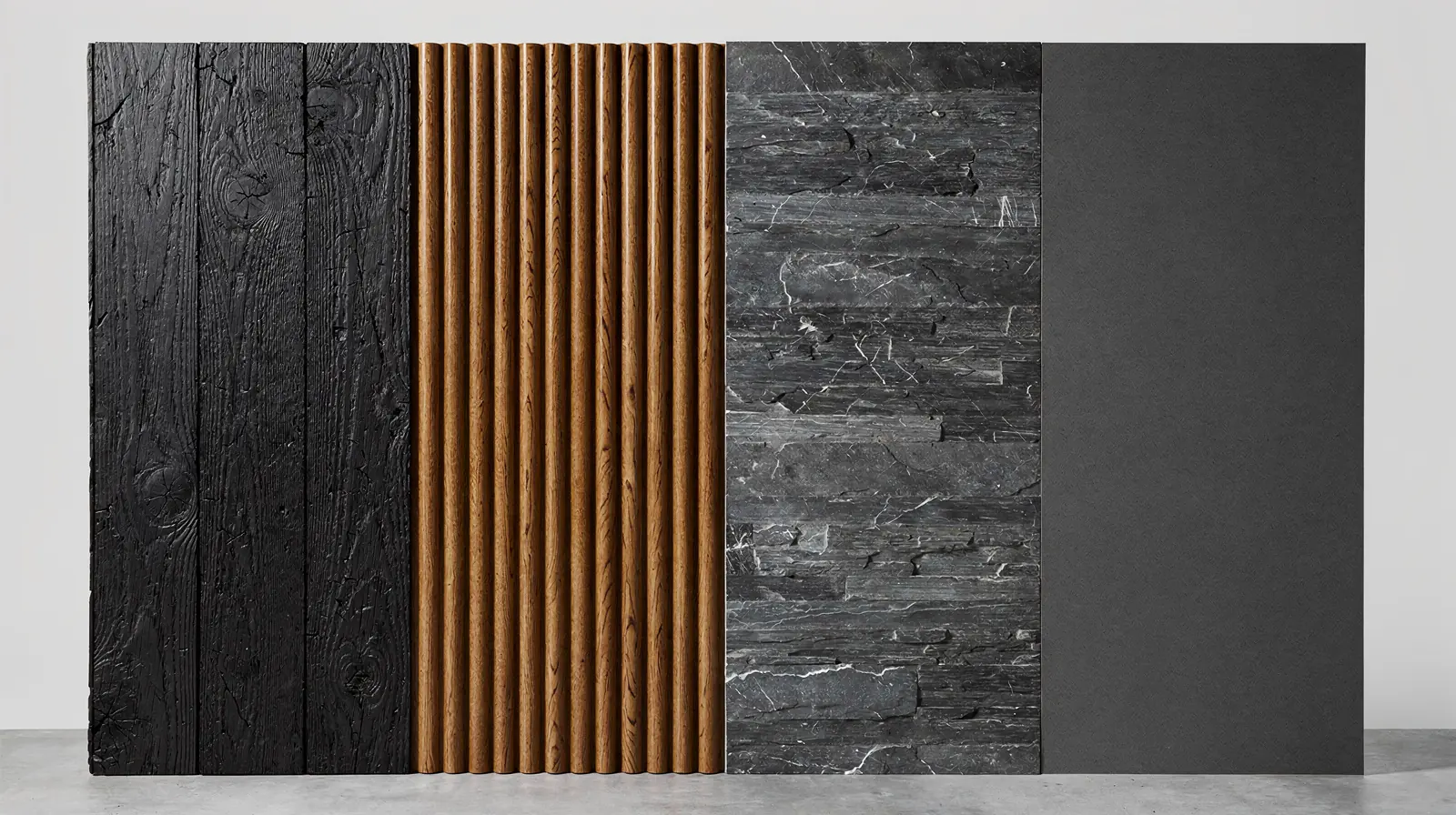
KUBIQ outdoor saunas are built in several material directions. Each is a legitimate choice — they differ by character, not by quality.
Charred wood (Shou Sugi Ban). Wood with a carbonised surface. The most common association is deep black, but charred does not have to mean black — it can be black, greyish or a warmer brown tone, depending on treatment intensity and finish. Detailed in the Shou Sugi Ban guide [/vodic/shou-sugi-ban/].
Lunawood thermowood. Thermally modified Nordic wood with a natural warm character. It comes in the classic honey tone (which naturally greys over time) and in the Arctic line (factory grey tone from day one). Detailed in the Lunawood guide [/vodic/lunawood/].
Flexible stone panel (SlateLite). Natural stone in the form of a thin, flexible panel. It gives an outdoor sauna a monolithic, architectural stone appearance — a direction wood cannot achieve. Visually closest to an “object”, not a “wooden cabin”. *(Detailed SlateLite guide in preparation.)*
Compact facade panel (MaxCompact). High-pressure compact panel, stable and clean modern appearance, flat surface without wood grain. A different visual language — architectural, contemporary, calm. *(Detailed MaxCompact guide in preparation.)*
Even from this short overview, it is clear that the choice is not “wood or black”. There are four directions with different character — and the decision is based on what suits your space and your expectations, not on what is most popular in renders.
Step 02Five questions that guide the decision
Material is not chosen from a colour catalogue. It is chosen through five questions.
### 1. What appearance do you want — and how does it fit the surroundings?
Charred black is dominant, attracts the eye, contrasts with greenery. Wood is warm and blends with nature. Stone is architectural and calm. A compact panel is contemporary and neutral. The key question is not “which one do I like most in a picture”, but “what makes sense in the space where it will stand”. A black cube in the middle of a Mediterranean garden with stone and olive trees communicates differently from the same black cube next to a modern concrete villa.
### 2. Do you want the material to change over time — or stay the same?
This is the decisive question most people skip. Natural wood (classic Lunawood) ages and greys — predictably and aesthetically, but it changes. If you want that liveliness and accept patina, it is an advantage. If you want the object to look the same in five years as it did on installation day, natural wood is not the right choice — or it needs regular coating maintenance. Charred, stone and compact panel materials change much less or almost not at all. The Arctic wood line gives a grey tone immediately, without transition phases. More on wood ageing: Lunawood guide [/vodic/lunawood/].
### 3. How much maintenance are you prepared to accept?
Materials differ in what they require after installation. There is no “maintenance-free” material — there is “less” and “more”. The question is how much you are realistically prepared to invest in appearance over the years.
- Natural stone and compact panels need the least attention.
- Lunawood thermowood — very low, washing with water without mandatory coating.
- Natural wood with retained colour — more, because it needs a pigmented UV coating every few years.
### 4. What context and climate?
The coast and the continent are not the same conditions. Full southern/western sun exposure accelerates wood ageing. Proximity to the sea, wind, humidity — all of it matters. A material that is perfect for a sheltered continental garden may not be optimal for an exposed Mediterranean terrace. This is the part of the conversation where the site context narrows the choice in concrete terms.
### 5. What kind of project — how much does the material carry the story?
On a smaller, clean object, the material is the whole statement. On a larger integrated wellness space, the sauna material has to speak with the terrace, cladding and surrounding elements. The larger the project, the less the material decision stands alone, and the more it becomes part of the whole.
Step 03Quick orientation
The table is not a verdict — it only shows direction. The final choice depends on your space.
Step 04When each material does not make sense
The most useful part is not saying what is good, but where each material gets it wrong.
- Charred black does not make sense if you want the sauna to blend into nature and disappear into greenery — a black cube does the opposite; it dominates. Also, if you do not want the object to be the strongest visual point in the garden.
- Natural Lunawood does not make sense if you cannot accept colour change and expect the object to look forever as it did on installation day — without willingness to maintain it with a coating. In that case, you go to Arctic, stone or panel.
- Stone (SlateLite) moves in the opposite direction from the warm, “living” natural character of wood — if that warm wooden atmosphere is what you are looking for, stone is not the right choice.
- Compact panel (MaxCompact) does not make sense if you want a natural material with character and texture — the panel is intentionally clean and flat, which some people experience as too technical or cold.
No material is universally best. The best one is the one that fits your combination of appearance, context, maintenance and project type.
Step 05What the decision looks like in practice
In the KUBIQ process, material is not selected from a catalogue at the beginning. The order is:
- Space and context — where the sauna stands, what surrounds it, what kind of exposure it has.
- The character you want — dramatic / warm / monolithic / neutral.
- Your attitude to ageing and maintenance — whether it changes or stays the same, how much effort.
- Narrowing to 1–2 directions — through conversation, not guessing.
- Samples and visualisation — the material is seen in the context of your space before the decision.
Material is the last layer to be locked, not the first. That way, the object ultimately looks as if it belongs to its space — not as if it was copied from someone else's render.