
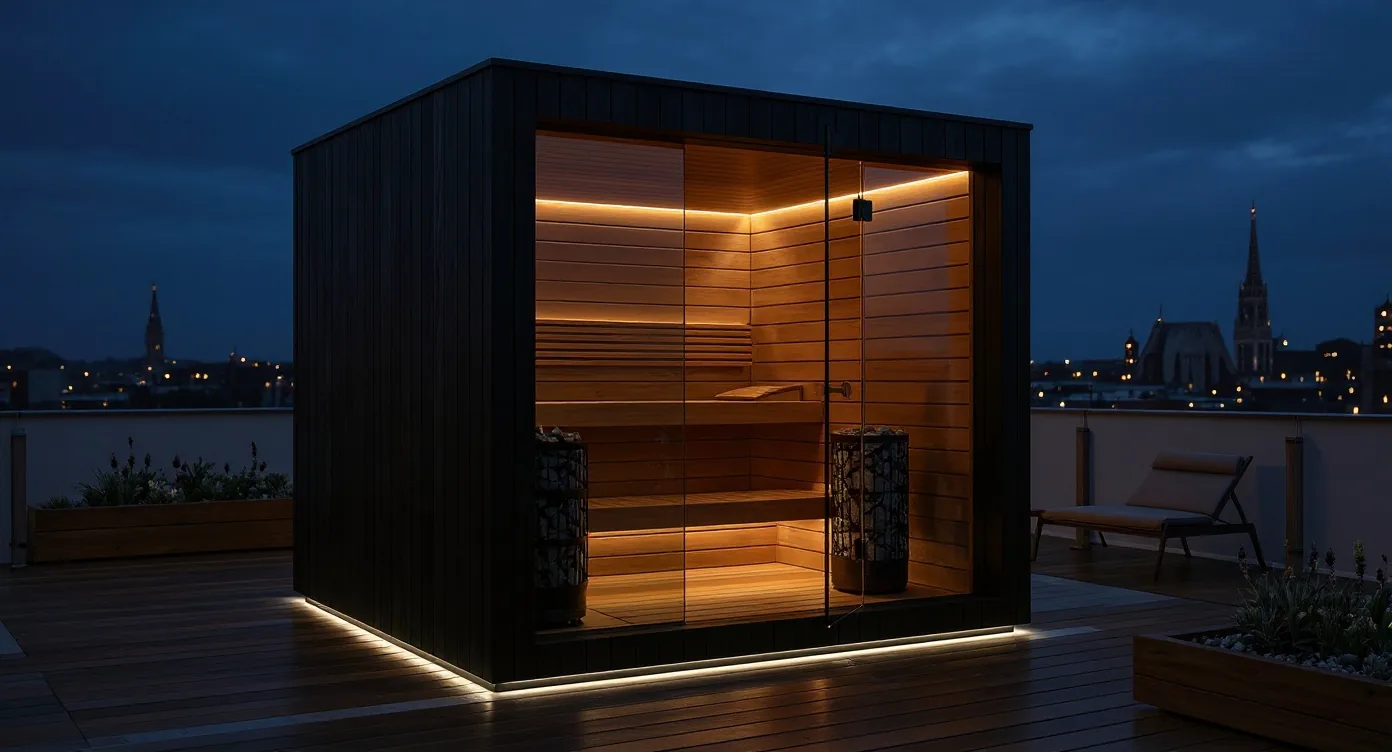
The centuries-old Japanese technique of controlled cedar charring is returning today as a premium architectural material — not because it looks extreme, but because carbonized wood outperforms many modern synthetic façades in several measurable dimensions.
A matte black façade, deep texture, contrast against the warm sauna interior — that is the visual signature. Behind that appearance is a simple material logic: controlled burning changes the surface of the wood and makes it more resistant to moisture, UV radiation and biological factors than most modern coatings.
This guide explains what the process actually does, the finishing variants, the wood species suitable for treatment, the practical advantages and limitations, and how a charred wood façade is maintained in real climatic conditions.
Step 01What is Shou Sugi Ban — the technical side
The traditional Japanese technique yakisugi (焼杉) dates back to the 18th century. Shō sugi ban (焼杉板) is the western adaptation of the name — “burnt cedar board” — which entered Anglo-American architectural circles in the 2000s and became a generic term for a carbonized façade.
The process in essence: a wooden board is exposed to flame in a controlled way until the surface layer carbonizes. Carbonization — the conversion of organic wood into a stable carbon layer — changes the surface properties of the wood on several levels:
- The surface layer (2–5 mm deep) loses cellulose and lignin
- A stable carbon layer remains that contains no nutrients for insects or fungi
- The surface pores close, drastically reducing water absorption
- UV absorption increases, but without UV-induced breakdown (the carbon is already in a stable form)
The wood is not simply “burned for the look”. The surface is chemically transformed into a layer with different properties from the original wood. This is the difference between a surface effect (paint, stain, oil) and a structural treatment that changes the material.
Step 02Three levels of carbonization
Shou Sugi Ban is not a monolithic category. There are three typical variants, depending on the depth of carbonization:
Suiyaki — light treatment
A light surface char, with a carbonization depth of 1–2 mm. The wood texture and grain remain visible. Colour: greyish to dark brown. The least visual impact, the least protection. Suitable for interiors or semi-protected exteriors.
Gendai — medium treatment
The standard architectural Shou Sugi Ban. Carbonization depth 2–4 mm. Dark matte-black colour, visible grain texture as relief. The most common execution in contemporary architecture and in premium outdoor sauna projects.
Sugiban — deep treatment
Carbonization of 4–6 mm, with a highly reliefed surface and large cracks in the carbon — “alligator skin”. Visually the most dramatic, with maximum protection, but aesthetically rustic. Less suitable for a modern architectural context, more common on historic Japanese buildings.
Finishing after burning
- Brushed. A soft brush removes the loose carbon layer, creating a smoother surface and clearer visible grain. Less carbon rubs off when touched.
- Sealed. A thin layer of natural oil (tung or linseed) or a specialized charred wood oil stabilizes the carbon layer and reduces transfer.
- Raw. No brushing and no oil. The most authentic look, but also the highest “crumbling” of surface charcoal in the first month — less suitable for façade zones where people move often.
The most common combination in the premium outdoor sauna context: gendai + brushed + sealed. An architectural profile without compromising maintenance.
Step 03Which wood can be carbonized
The traditional application: Japanese cedar (sugi, Cryptomeria japonica). The reason: its soft structure accepts carbonization evenly, and the grain shows a clear contrast after burning.
What works well:
- Japanese cedar — the traditional choice
- Western Red Cedar — the most common substitute in western architecture
- Thermo pine (Lunawood, Thermory) — a modern alternative, where dimensional stability before burning reduces cracking of the carbon layer over decades
- Oak — possible, but not optimal; the dense material requires longer burning time and the result is less even
What does not work:
- Resinous woods (spruce, fir) — resin is released during burning, the result is uneven, and sharp smells remain for months
- Poplar, linden — overly sensitive structure; they burn away more than they carbonize
- Dense tropical woods (teak, ipe) — too dense; carbonization is superficial and uneven
A thermally treated base before carbonization is the premium approach. Thermo pine (Lunawood Triple class) undergoes thermal modification at 215 °C before the Shou Sugi Ban process. Thermal treatment stabilizes the wood dimensionally; the combination with carbonization produces a façade that twists less, cracks less and retains the carbon layer longer over 20+ years.
Step 04What carbonization really gives (and what it is NOT)
Marketing around Shou Sugi Ban often slides into exaggeration. The difference between real measurable advantages and myths:
What carbonization really gives
- Resistance to insects. The carbon layer has no nutritional components — wood-boring insects, termites and larvae lose interest. The material becomes biologically “dead” for pests.
- Resistance to moisture. Closed pores plus the carbon layer — drastically lower water absorption than untreated wood. Not impermeable, but significantly more resistant.
- UV stability. Carbon is already in a stable form and does not degrade under UV radiation like cellulose. The façade retains a deep dark shade without the greying characteristic of untreated wood.
- Slower response to fire. The surface carbon is already in a “burned” state and requires higher temperature and longer exposure for further burning. Note: it is not “fireproof” in a legal sense — it does not replace a fire protection system and it does not carry a classification mark.
What carbonization is NOT
- It is not permanent. Over decades, the carbon layer becomes thinner on exposed surfaces. Service life of a matte-black façade without renewal: 15–20 years, depending on climate. With selective oil renewal: 30+ years.
- It is not maintenance-free. “Low maintenance” does not mean “no maintenance”. Washing once per year, oil refreshment every 5–8 years.
- It is not for every aesthetic context. A dark façade can visually reduce space, intensify the feeling of enclosure in small yards, and needs contrast (a light cooling zone, warm lighting) to function well. Micro-location and environmental contrast are covered in site preparation.
- It is not a universal replacement. Classic thermo façades (natural Lunawood) have their place — lower cost, different character, different ageing. Shou Sugi Ban is not “better” — it is different.
Step 05Aesthetics over decades
Charred wood does not age like classic wood. It does not grey through UV exposure, does not lose colour in the same way, and does not need periodic renewal in order to “look like new”. But it does change, and that change is part of its character.
The first year
The most intense matte-black colour. The surface carbon is fresh and fragments can rub off when touched (if the finish is raw, not sealed). The surface absorbs traces of dust, pollen and rain minerals — but this is not staining, it is accumulation that is rinsed away by rain.
Years 2–5
The carbon layer stabilizes. Colour depth decreases slightly, but remains matte black. Contact points (edges, handles, the area around the door) can show a slight shift toward grey. The strongest period of character — the façade looks “settled in”.
Years 5–15
Gradual patination. Individual elements show subtle differences in tone depending on orientation toward sun and rain. The north façade often remains deeper black, while the south façade can become slightly grey-black. This is not deterioration — it is the material’s response to the location.
Years 15+
The carbonized layer naturally becomes thinner on the most exposed surfaces (upper edges, parts exposed to slanting rain). The wood below the carbon remains structurally healthy. Possible renewal — selective re-application of oil or local re-carbonization of the most worn surfaces.
The principle of wabi-sabi
The Japanese aesthetic concept wabi-sabi (侘寂) is the framework for understanding Shou Sugi Ban over time: accepting the beauty of natural ageing, texture and subtle imperfections.
The material is not meant to be kept “like new”. Character is built over years. Trying to return a 10-year-old façade to its first-year condition is aesthetically wrong — the patina, which has value in itself, is lost.
Step 06KUBIQ Eclipse Charred Black — context
KUBIQ Eclipse Charred Black is the flagship outdoor sauna that integrates Shou Sugi Ban as the central material choice:
- Carbonization: gendai level (2–4 mm)
- Finish: brushed + sealed
- Wood base: thermally treated Lunawood — high-grade thermo pine, dimensionally stable before carbonization
- Interior: brushed thermo alder, light honey tone — an intentional contrast against the black exterior façade
- Format: 280×260 cm exterior footprint, models with integrated cold plunge or lounge zone
- Heater: Tulikivi bespoke soapstone (premium configuration)
- Control system: SIOP ecoReg ClearVision with WiFi
- Glazing: grey tinted tempered glass, optional electrochromic smart glass
Eclipse Charred Black is designed as an outdoor wellness architectural element, not only as a sauna. The contrast between the dark carbonized façade and the warm interior is the central aesthetic thesis of the model — a dramatic transition on entry that psychologically strengthens the ritual.
Step 07Maintaining a charred wood façade
The biggest mistake with Shou Sugi Ban is too much active maintenance. Less is more.
Annual inspection (spring)
- Visual inspection of the façade, especially the upper edges and the east/south side (highest UV exposure)
- Checking for possible cracks or broken pieces (rare, but it can happen with extremely deeply carbonized panels)
- Checking joints with the roof, windows and entrance doors — the places where carbon deteriorates fastest
Washing (once per year or as needed)
- Garden hose with a mild stream, soft brush for hard-to-reach areas
- Wash from top to bottom, in the direction of the grain
- No pressure washer from close range — pressure can remove the carbon layer in uncontrolled places
- No detergents — soap is not necessary; water is enough to remove dust, pollen and mineral deposits
Selective renewal (every 5–8 years)
- Specialized oil for charred wood — typically a mixture of tung and linseed oil
- Apply thinly, in one layer, on a cleaned and completely dry façade
- Allow 30–60 min to absorb
- Drying time 24–48 hours before contact with water
- Do not sand before applying oil — sanding removes the carbon layer that is precisely intended to be protected
What to avoid
- Sanding the carbon layer — this removes protection, it does not renew it
- Painting over carbonization — paint does not adhere to the carbon layer and flakes off in the first season
- Trying to re-carbonize the entire façade on site — that is workshop work, not field work. Local re-carbonization of individual boards is possible, but it requires controlled conditions.
Step 08When Shou Sugi Ban is NOT the right choice
Premium aesthetics do not mean a universal solution. Contexts in which charred wood does not work well:
- Micro-yards with dark surroundings — a dark façade visually consumes space and intensifies the feeling of enclosure
- Neutral or light architecture of the house — a Shou Sugi Ban sauna can visually dominate and contradict the main building
- A client who does not want the appearance to change over the years — patination is part of the character, not a flaw; anyone who wants “like the first day forever” needs a different material
- Locations with extreme UV exposure and no shade (for example flat islands without vegetation) — the façade will patinate faster than in a continental climate
- A project with a limited budget for a premium material — Shou Sugi Ban execution requires controlled burning conditions, qualified craftsmen and a high-quality thermal base. The price reflects the process.
An alternative for projects that do not fit Shou Sugi Ban criteria: classic thermo façades (natural Lunawood, Thermory) or oiled cedar. Different character, their own qualities, less demanding production process.
Frequently asked questions
Can I do a Shou Sugi Ban treatment myself on an existing façade?
Technically yes, practically rarely useful. Professional burning uses controlled gas burners and considers angle, movement speed and wind conditions. An improvised treatment gives an uneven result — local over-burning, parts that are not carbonized at all, cracks. If it is for a sauna — it should be part of the execution, not a DIY adaptation of an existing façade.
How does Shou Sugi Ban react to salt in the air (coastal areas)?
Better than most alternatives. The carbon layer does not react with sea salt like cellulose, so a façade near the sea does not deteriorate faster than one in a continental climate. Seasonal washing with rainwater or a garden hose removes surface salt deposits.
What if a crack appears or a piece of board breaks off?
Local replacement of an individual board is standard service. Quality contractors keep reserves of the same material for 5–10 years after installation. Attempts to “patch” a carbonized surface with improvised methods (paint, stain, polishing paste) do not work — the compromise is visible.
Is charred wood resistant to graffiti or vandalism?
The carbon surface absorbs spray paint differently from wood — spray rarely penetrates deeply and remains on the surface. Removal: citrus-based chemical solvent, locally and carefully. In extreme cases — replacement of an individual board.
Can I have a sauna in a material that is not black?
Yes. Wood tones with other treatments: thermo wood (honey-brown, matte), natural Lunawood (light brown), oiled cedar (warm reddish), polished oak (dark with grain). Charred wood does not have to be completely black — there are variants with lower carbonization depth (suiyaki) that leave the grain visible.
How much longer does charred wood last compared with ordinary wood?
Without treatment: charred wood 25–30 years vs. ordinary wood 10–15 years. With regular maintenance: charred wood 40+ years vs. ordinary wood 20–25 years (with periodic retreatments). The difference is not only longevity — it is also the quality of the visual character over that time.