
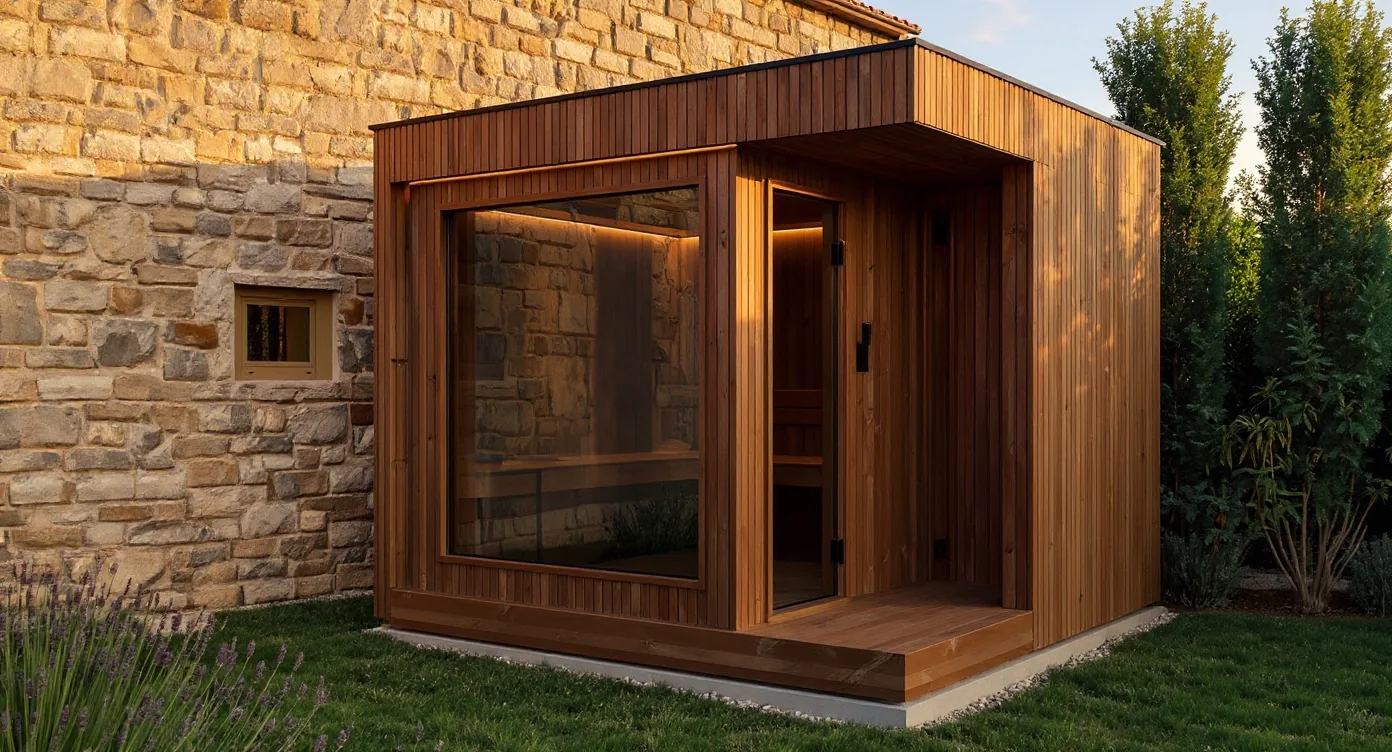
With an outdoor sauna, the exterior material is not only a question of appearance.
The façade has to withstand sun, rain, frost, temperature changes, UV radiation and constant exposure to the environment. At the same time, it must retain an architectural character and the feeling of a natural material. Inside, the sauna works with temperatures up to 90 °C and steam; outside, with continental or Mediterranean climatic extremes. The material that connects these two worlds is not decoration — it is a technical decision.
The classic solution usually means two compromises: chemical impregnation, which requires sanding and coating every two years, or tropical wood (ipe, teak), with a high ecological, ethical and regulatory burden.
The third way — thermal modification of Nordic wood — uses heat and steam as the only “treatment”. The wood changes chemically at the level of its cellular structure, without chemicals and without foreign substances. After modification, the material lasts for decades outdoors without coatings and chemical protection.
Lunawood is a Finnish Thermowood manufacturer that has standardized this process. In KUBIQ projects, Lunawood carries the role of the exterior cladding — it enables the sauna to remain natural, warm and architecturally clean on the outside, with far more predictable behaviour than ordinary wood.
This guide explains what Lunawood is, how it is made, which classes exist, how it ages, what not to expect, and why it is used in outdoor wellness architecture.
Step 01What is Lunawood
Lunawood is a Finnish manufacturer of thermally modified Nordic wood, founded in 2000 and one of the founders of the International ThermoWood Association. Production is based in Iisalmi in central Finland, where the wood is geographically sourced from PEFC-certified Nordic forests with sustainable management.
Lunawood Thermowood is produced through a process that uses heat and water steam, without adding chemicals to the wood. This means that the properties of the wood are not changed by a surface coating, but through the structure of the material itself.
In other words: Lunawood is not ordinary wood that has been “coated” on the outside. It is wood that has passed through a controlled thermal process and therefore behaves differently from untreated wood.
What separates Lunawood from other thermo manufacturers:
- Continuous kiln system — production in a continuous flow, not in batch cycles. Result: more uniform treatment depth, more consistent colour, predictable mechanical properties of every board.
- BRE-accredited service life of 30 years for exterior façade use (Building Research Establishment, UK).
- Durability class 2 according to BS EN 350 — the second-highest resistance class, without chemical additives.
- 20-year manufacturer’s warranty for projects in the EU.
- PEFC certification and EPD (Environmental Product Declaration), documenting the carbon footprint across the full life cycle.
Step 02How thermo wood is made
Thermal modification (English thermal modification, Finnish lämpökäsittely) is a process in which wood is exposed to high temperature in a controlled atmosphere of water steam — without oxygen and without chemical additives.
Water steam has a triple role: it prevents the wood from igniting at extreme temperatures, controls the drying process and acts as a medium that prevents structural cracking.
Standard process:
- Drying (50–100 °C) — controlled removal of moisture from the wood
- Thermal modification (185–215 °C) — the wood is heated in a steam atmosphere where the real chemical transformation takes place
- Cooling and conditioning — gradual lowering of temperature and equalization of moisture
The full cycle lasts 36 to 96 hours, depending on the thickness of the wood and the target treatment class.
What happens to the wood at molecular level
At 185–215 °C, the wood goes through several permanent changes:
- Hemicellulose breaks down. Hemicellulose is the component of wood that absorbs the most moisture. By removing it, the wood permanently loses hydrophilicity — the ability to absorb moisture is significantly reduced, together with swelling and shrinkage of the boards.
- Resin comes out. Nordic pine and spruce naturally contain resin that can leak outdoors and leave marks. Thermal modification eliminates resin — the façade never shows resin stains in summer heat.
- Sugars caramelize. The wood gains its characteristic honey-brown to dark-brown colour through the full thickness, not only on the surface.
- Biological nutritional value disappears. Fungi and insects lose interest — the wood no longer has nutritional components that attract them.
The difference between chemical impregnation and thermal modification
| Characteristic | Chemical impregnation | Thermal modification |
|---|---|---|
| Treatment composition | Biocides, salts, sometimes heavy metals | Only heat and steam |
| Protection depth | Surface layer (a few mm under pressure) | Through the full thickness of the board |
| Dimensional stability | Wood still moves (expands, shrinks) | Movement reduced by up to 50 % |
| Maintenance | Sanding and coating every 2–3 years | Washing with water once per year |
| Safety in a sauna | Strictly prohibited (toxic emissions) | Safe — only the aroma of wood |
That is the difference between protection over the wood and changing the wood itself.
Step 03Lunawood classes: Thermo-S and Thermo-D
Thermal modification is carried out in two basic levels, depending on the final application:
Thermo-S (Stability)
- Treatment at 190 °C
- Emphasis on stability while preserving mechanical strength
- Colour: honey-brown, medium intensity
- Application: interior, furniture, semi-protected exterior
- Durability class 3 according to BS EN 350
Thermo-D (Durability)
- Treatment at 212 °C
- Emphasis on durability, maximum dimensional stability
- Colour: dark brown, consistent through the full thickness
- Application: façades, terraces, exterior cladding exposed to full weather conditions
- Durability class 2 according to BS EN 350 — the second-highest resistance class
KUBIQ engineering standard: for all exterior façades and exterior claddings on wellness objects, Thermo-D class is used. This enables the integration of hidden fixing clips without visible screws, with confidence that the panels will not twist, deform or crack under atmospheric influence.
Wood species in the Lunawood line
Lunawood produces thermally modified products from two Nordic species:
- Nordic pine — the traditional base for façades and terraces. Density approximately 420 kg/m³ at 6–8 % moisture. Characteristic visible grain.
- Nordic spruce — finer structure, less visible grain, smoother visual impression. More common in designer 3D profiles such as Luna Triple.
Step 04Luna Triple 32×140 — KUBIQ choice
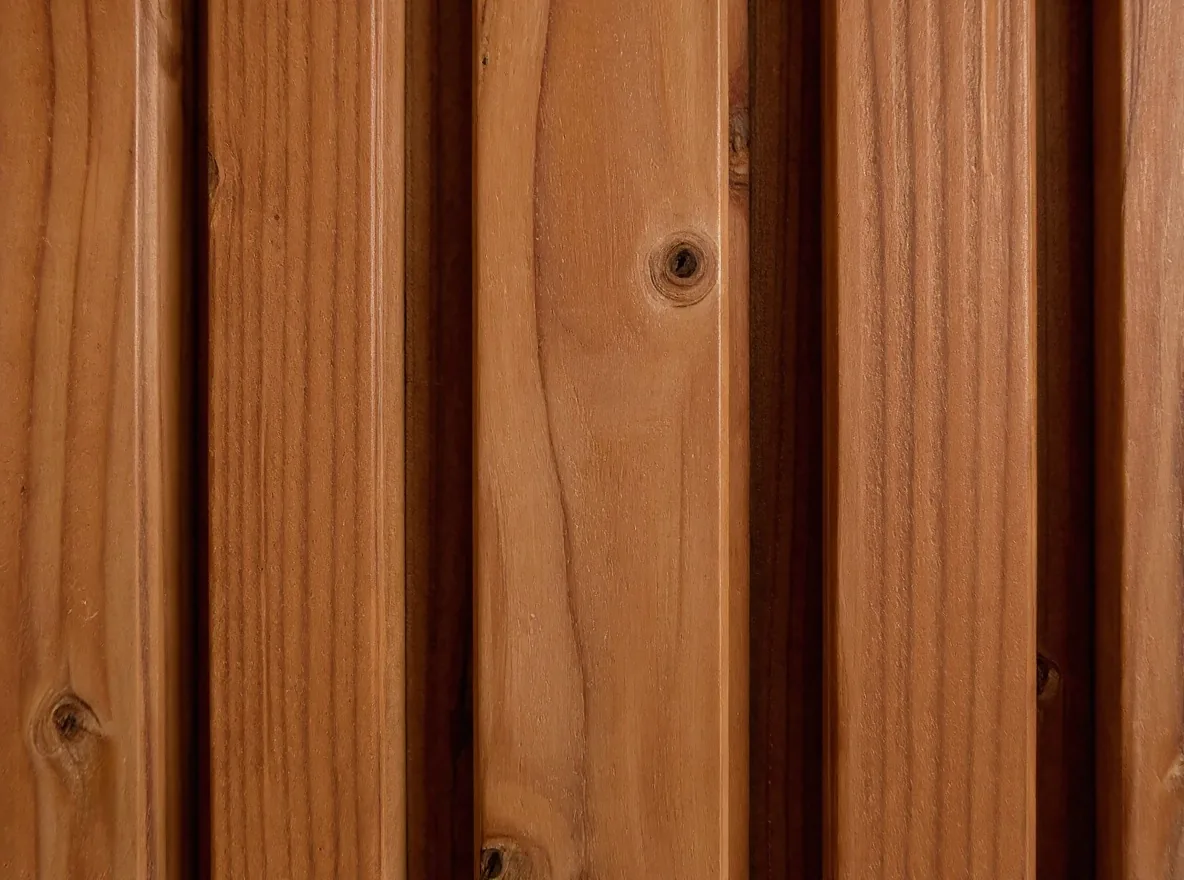
In the KUBIQ Eclipse line and studio projects, Luna Triple 32×140 mm is used as standard. It is an award-winning 3D profile made from Nordic spruce, with two deep grooves that simulate the appearance of fine wooden slats, but in the form of a solid tongue-and-groove panel.
Why Luna Triple specifically:
- Deep grooves create rhythm and shadow — the façade is not flat and ordinary; it has a vertical structure that changes throughout the day
- Hidden joints (hidden clip fastening) — no visible screws, cleaner architectural form
- Winner of the Architecture MasterPrize 2021 in the sustainable products category
- Compatible with a prefabricated panel — KUBIQ 162 mm wall system (Lunawood 32 mm exterior + 75 mm stone wool insulation + vapour barrier + 15 mm thermo alder interior)
In the KUBIQ visual language, this matters because an outdoor sauna should not look like a garden shed. It should look like a designed wellness object.
An alternative variant — Luna Arctic Triple 32×140 Brushed — is used for projects that require an instant grey tone from the day of installation, without going through the honey-coloured phase. Brushed surface treatment plus factory-applied silver-grey coating.
Step 05How Lunawood ages
Lunawood is natural wood. That means it ages.
But the point is not that the wood never changes colour. The point is that the change happens predictably and in an aesthetically acceptable way. Under the influence of UV radiation and rain, surface lignin in the wood goes through natural oxidation and changes colour through recognizable phases.
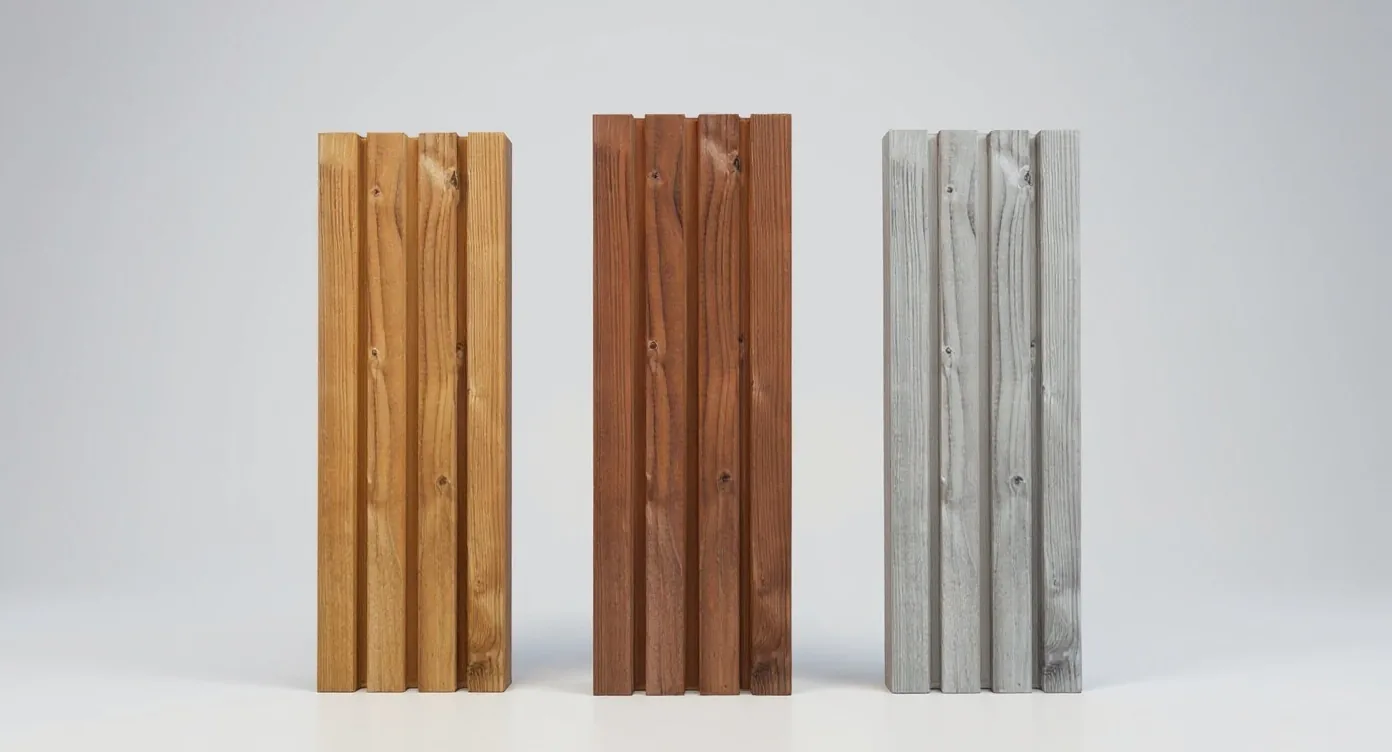
Ageing phases
New (0–3 months). Warm honey-brown to darker brown shade, depending on wood species and treatment class. A gentle satin sheen that disappears during the first few months.
3–6 months. Slight lightening, the surface becomes more even. Beginning of the patination process.
6–12 months. Natural greying becomes visible, especially on the south and west sides of the façade.
1–2 years. A uniform silver-grey patina begins to dominate. Subtle tone differences can be seen between exposed and sheltered sides of the object.
2+ years. Stable patina — a lasting and aesthetically refined appearance. The patina is surface-level (less than 0.1 mm); the wood below remains structurally healthy and resistant.
The speed of patination depends on orientation, climate and the microclimate of the location:
- South and west façade — greys fastest (full UV exposure)
- North façade — slower, can keep the honey tone longer
- Under an overhang or roof extension — slowest, can remain brown for years
This creates subtly different tones on the same object, which is an aesthetic part of the character of wood — not a defect. In premium outdoor wellness architecture, natural ageing is often part of the character of the object.
Step 06If you do not want natural greying
Three strategies for managing the aesthetics:
Accept the natural patina (wabi-sabi approach). The most common choice in premium outdoor wellness. The wood ages organically, requires minimal maintenance (washing with water once per year), and perfectly communicates the philosophy of architecture living with nature.
Retaining the honey colour. If you want to permanently retain the warm initial shade, the façade should be treated immediately after installation with pigmented UV-protective oils (for example the SiOO:X system). The process requires periodic renewal every few years.
Instant grey architecture (Luna Arctic line). For projects that want a stable grey tone from day one, without transitional brown phases. Factory-treated profiles with a silver-grey coating that gradually washes out over the years while the natural grey of the wood develops underneath.
The least maintenance means: allow the wood to patinate naturally. The most control over colour means: regularly maintain the surface with an appropriate coating. There is no universally better option. It depends on whether the user wants natural patina or retention of a specific tone.
Step 07Lunawood as a base for other treatments
The thermal stability of Lunawood makes it the preferred base for further surface treatments:
- Shou Sugi Ban (charred wood) — a carbonized surface on a thermally modified base. Explained in the Shou Sugi Ban guide. KUBIQ Eclipse Charred Black uses this combination.
- UV-protective coatings (SiOO:X and other variants) — they prolong the honey tone without compromising dimensional stability.
- Brushed finish — mechanical treatment, emphasizes the grain and creates a more tactile experience. Standard for premium Lunawood lines.
All these variants upgrade Lunawood, they do not change its character. The base remains thermally modified Nordic pine or spruce.
Step 08What Lunawood is NOT
For communication to remain realistic, it is important to state clearly what Lunawood is not:
- It is not a material that never changes. It ages — only differently and more predictably than ordinary wood.
- It is not immune to micro-cracking. Over years of exposure to extremes, fine microscopic longitudinal cracks will appear on the surface. This is a normal physical reaction of wood, not a sign of deterioration. Lunawood explicitly mentions this as part of the material’s character.
- It is not completely waterproof. Wood still absorbs water — less than untreated wood, but not zero. That is why a vapour-open, waterproof membrane behind the ventilated air layer is mandatory in the prefabricated 162 mm wall system.
- It is not a load-bearing structural element. Thermal modification at 212 °C reduces the elasticity and bending strength of wood. The wood becomes more brittle. That is why Lunawood is used exclusively as premium exterior and interior cladding, while the load-bearing structure is made from high-strength KVH/BSH beams.
- It is not universally better than every wood. Tropical woods (ipe, cumaru) have higher density and a longer life without treatment, but they are expensive and regulatory-problematic. Cedar (Western Red) has a different character and natural resistance, but lower dimensional stability. Lunawood is a premium choice for a Nordic profile and predictability — not universally “the best”.
- It is not a substitute for correct façade ventilation. Even the best material can function poorly if it lacks proper ventilation, drainage, spacing and joint execution.
Step 09Lunawood vs. alternatives
A quick orientation when considering different façade materials for outdoor wellness:
| Material | Cost | Maintenance | Sauna safe? |
|---|---|---|---|
| Standard wood | Low | High (sanding, coatings) | Yes, but wears quickly |
| Chemical impregnation | Low | Medium | NO — toxic emissions |
| WPC composite | Medium | Low | No — plastic feel |
| Lunawood (Thermo) | Higher | Very low (water wash) | Yes — safe up to 200 °C |
Ordinary wood. More affordable, but requires more maintenance — sanding, coating, periodic renewal. Low dimensional stability.
Chemically impregnated wood. Standard solution for rustic applications. Unacceptable from a safety perspective for saunas (toxic emissions when heated). Aesthetic compromise.
Cedar (Western Red). Naturally resistant, pleasant scent, classic character. Lower dimensional stability, more expensive import, requires periodic oil treatment.
Ipe / Cumaru / tropical woods. Maximum density, 30+ years without treatment. High price, regulatory issues, ethical questions. Use is declining.
WPC / composite. Maintenance-free, predictable appearance. Visually dead, does not age, does not breathe. Large thermal expansion in an outdoor sauna context.
Compact façade boards (HPL). Stable modern appearance. They do not have the natural character of wood — a different visual language.
Lunawood Thermo-D. No chemicals, dimensional stability, predictable durability of 25–30 years without treatment, BRE accreditation, EU origin, PEFC certification. Premium position with an authentic wood character.
The choice depends on the project, location, budget and aesthetic preference. For KUBIQ outdoor wellness architecture, Lunawood has been chosen as the standard because it gives predictable behaviour and authentic wood character without compromising longevity.
Step 10The most common mistakes in understanding thermo wood
Thinking that thermo wood never ages. It ages — only differently and more predictably. Colour change and gradual patination are a natural part of the life cycle.
Thinking that natural patina means deterioration. In a properly executed façade, greying is a surface change in appearance — the wood below remains structurally healthy and fully resistant.
Using the wrong type of wood in the wrong place. Wood for the façade, wood for the sauna bench and wood for the load-bearing structure do not have the same requirements. Lunawood for the façade, thermo alder for the sauna interior, KVH/BSH for the load-bearing structure. Different roles, different materials.
Ignoring installation details. Even the best material can function poorly if it lacks correct ventilation, vapour-open membranes, expansion gaps and joint detailing. The material is part of a system, not a solution by itself.
Site preparation explains the technical details related to installation.
Frequently asked questions
Does Lunawood need a coating or treatment after installation?
No, it does not. Lunawood Thermo-D is a complete material for exterior execution without any coating. Coatings are an option if the honey tone is to be retained — without them, the wood gradually greys, which is aesthetically equally legitimate.
How quickly does Lunawood become grey?
It depends on location, orientation and UV exposure. South and west façades — visible greying in 6–12 months, uniform patina in 2–3 years. North façades and shaded parts — significantly slower, can retain the honey tone for 3–5 years. Patination is superficial; the wood below remains structurally stable.
Can Lunawood be painted?
Technically yes, practically rarely useful. Painting wood that is thermally stable and predictable in its natural form, only to obtain another colour, makes little sense. A better approach: choose an alternative material that already has the desired colour, or use the Luna Arctic line for an instant grey appearance.
Is there a difference between Lunawood and other ThermoWood manufacturers?
Yes. ThermoWood is a generic process (Finland Wood Standardization), but execution quality varies between manufacturers. Lunawood is one of the founders of the International ThermoWood Association and uses continuous kiln instead of a batch process, which gives a more consistent result. Other quality thermo-wood manufacturers (Thermory from Estonia) have their own standards and advantages.
Is Lunawood an ecologically sustainable choice?
Yes. Nordic pine and spruce come from PEFC-certified forests with sustainable management. The production process uses only heat and steam — without chemicals that would require wastewater treatment. Lunawood has an EPD (Environmental Product Declaration) documenting the carbon footprint of the material across its full life cycle.
Can I use Lunawood inside the sauna?
Lunawood has a specific class for sauna interiors (Luna Sauna Thermowood), adapted to high temperatures. KUBIQ uses brushed thermo alder for the sauna interior, not Lunawood — a decision based on the tactile character of wood at temperatures of 80 °C. Wood for sitting and wood for a façade do not have the same requirements.