
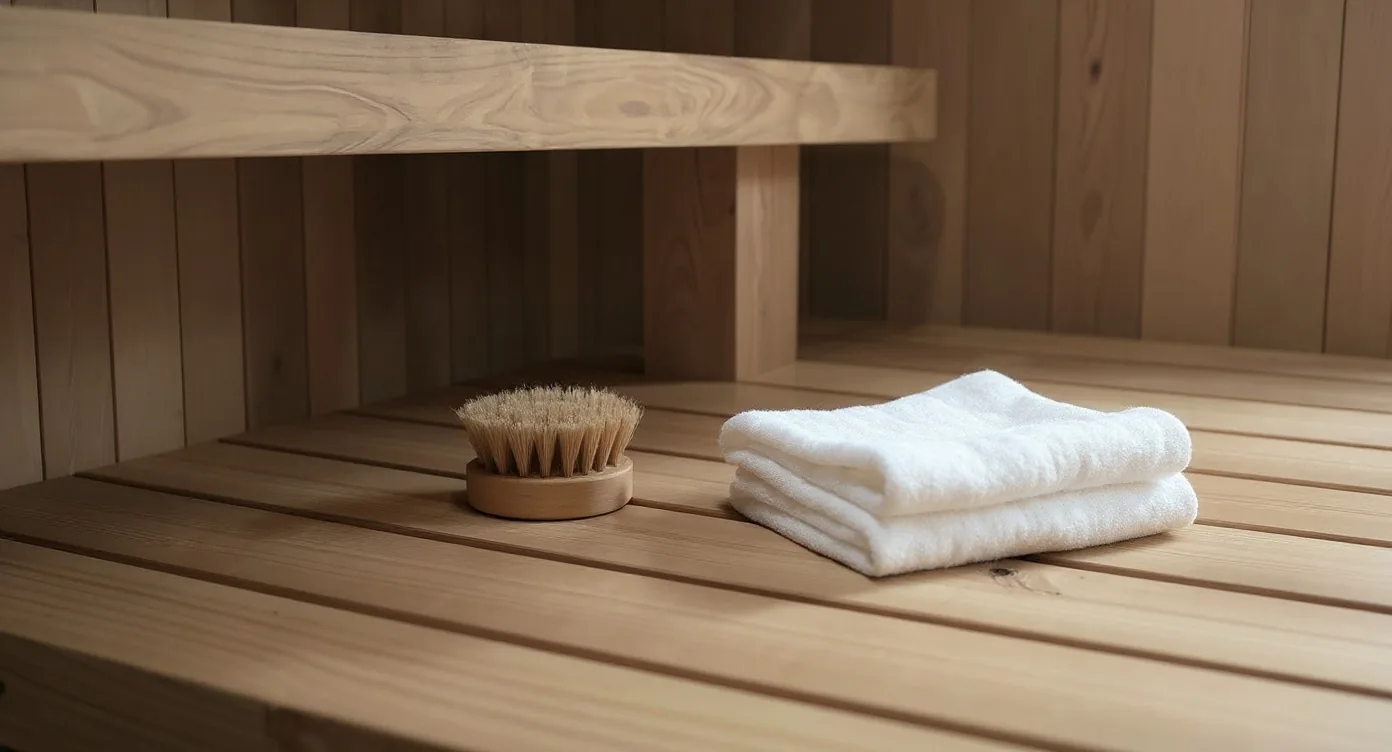
Wood in a sauna is a living material in a space that, by all rules, it should not tolerate well: 80 °C, a humidity cycle, sweat, cooling and then heating again. No treatment, no chemical protection, no coating. The fact that a sauna remains functional for 20+ years is not because of chemistry — it is because the wood was chosen to withstand those conditions.
Maintenance that follows that principle works simply. Maintenance that tries to "strengthen" the natural process with industrial products does not work, and in some cases causes damage.
This guide explains what should be done, what should not be done, and what the sauna as a space does by itself without intervention.
Step 01Principle: what the sauna does by itself
The high temperature of the sauna is a steriliser. Bacteria and most moulds do not survive repeated exposure to 70–90 °C, especially during the dry heating phase. Wood that is used regularly does not need disinfection — sterilisation happens by itself.
What that means in practice: antibacterial agents, disinfectants or bleaches are not used in a sauna. They do not bring additional hygiene, but they bring residues that release fumes at 80 °C into a space where people breathe deeply.
This reverses the logic of maintenance: in a sauna, you do not clean for sterilisation, you clean to remove visual and tactile traces of use — sweat, stains, surface dust. The difference is important because it changes the choice of cleaning product.
The principle of dry heat as a steriliser is explained in Finnish sauna — the thermodynamics that make a sauna naturally clean are the same mechanics that make it ritually effective.
Step 02Prevention — where 80% of cleaning actually happens
Towel, shower before entry, drying after the session. Three simple procedures that reduce actual cleaning to a minimum.
Towel as a barrier
Direct contact of bare skin with a wooden bench transfers sweat, skin oil, remains of creams and deodorants. The wood absorbs all of that. A towel of sufficient size (the entire contact surface — seat, back, feet when lying down) is the primary protection of the benches. The Nordic standard is bare skin with a towel under the body, not over it. Synthetic towels are not the solution — at 80 °C they release microparticles and chemical smells. Cotton or linen.
Shower before entry
Five minutes under warm water before the sauna removes everything from the skin that the wood would absorb: perfume, creams, deodorant, natural skin oil. The shower is often skipped as "not necessary", but this is the moment that saves the most bench maintenance over the years. The difference between a sauna that looks new after 5 years and one that is dark and stained — mostly lies in the consistency of this step.
Drying after the session
The single most important thing that extends the service life of the sauna. After the final entry, the door is left open for 30–60 minutes. If the controller allows it, a "drying mode" is activated — short low heating with the door open until the cabin reaches room temperature.
Drying prevents condensation inside cladding and panels — the largest hidden risk to longevity. What looks from the outside like a minor step (just opening the door) is actually the difference between a wooden construction that lasts 20+ years and one that starts showing problems after 5–7.
Step 03Cleaning frequency
Different interventions have their natural rhythm:
After every session (5 minutes):
- The towel is removed from the sauna, not left inside
- Door open for drying
- Any sweat stains on benches are wiped with a damp clean cloth while the wood is still lukewarm
Weekly (15 minutes):
- Wipe benches, backrests and bench edges with a damp cloth (water only, no products)
- Check tightness of bench joints (screws)
- Wipe dust from ventilation openings
- Check heater stones — arrangement and cleanliness
Monthly (30 minutes):
- More detailed cleaning of benches with a soft brush + mild soap for sauna wood + water, in the direction of the grain
- Wipe ceiling and walls with a damp cloth
- Check floor grates, clean between slats
- Detailed check of door, hinges and seal
Annually (2–3 hours):
- Inspection of all wooden elements
- If needed: fine sanding of stains (P180–P240)
- Application of paraffin oil for saunas on benches and backrests (if the wood is absorbent — thermo alder, abachi)
- Service check of heater, elements, controller (recommended)
- Check of the ventilation system
Frequency is adjusted to intensity of use. A sauna used 4× per week needs different attention from one used 1× per week.
Step 04Monthly cleaning procedure
Step by step:
- The sauna must be completely cold and dry. Never clean immediately after a session or while the cabin is still warm.
- Lukewarm water (around 30 °C) in a bucket, small amount of mild soap intended for sauna wood.
- Soft brush — synthetic with soft fibres. Not wire, not hard plastic.
- Brush only in the direction of the wood grain, with light pressure. Brushing across the grain opens the wood structure and makes the surface more sensitive to future stains.
- Wipe with a clean damp cloth (water only) to remove soap residue.
- Door open for 1–2 hours for drying.
- If needed: short heating (drying mode, 40–50 °C, 30 min) to complete drying.
What to avoid in this procedure: excess water on benches, products intended for wood outside the sauna, abrasive brushes, cleaning across the grain.
Step 05Stubborn stains — fine sanding, not stronger chemistry
Stains that cannot be removed by mild washing do not need stronger chemistry — they need local fine sanding.
- Sanding paper or sponge P180–P240 (P180 for stronger stains, P240 for fine smoothing)
- Light pressure, only in the direction of the grain
- Only on the affected area, not on the whole bench
- After sanding: vacuum dust, wipe with a damp cloth, leave to dry
The advantage of quality sauna wood — especially thermo alder, which KUBIQ uses in sauna interiors — is that the surface layer can be renewed without aggressive products. The surface returns to a lighter tone, the wood smell is renewed, the touch becomes smoother.
What not to do: sand the entire bench surface or "rejuvenate" the wood by deep sanding. With years of use, wood develops structural saturation in the surface layer — aggressive sanding removes that layer, the bench becomes absorbent like new, and the stain cycle starts again.
Step 06Treating benches with paraffin oil
Sauna walls and ceiling remain untreated — the wood must breathe and react naturally to the microclimate of the space. Benches and backrests can be periodically treated with specialised paraffin oil for saunas.
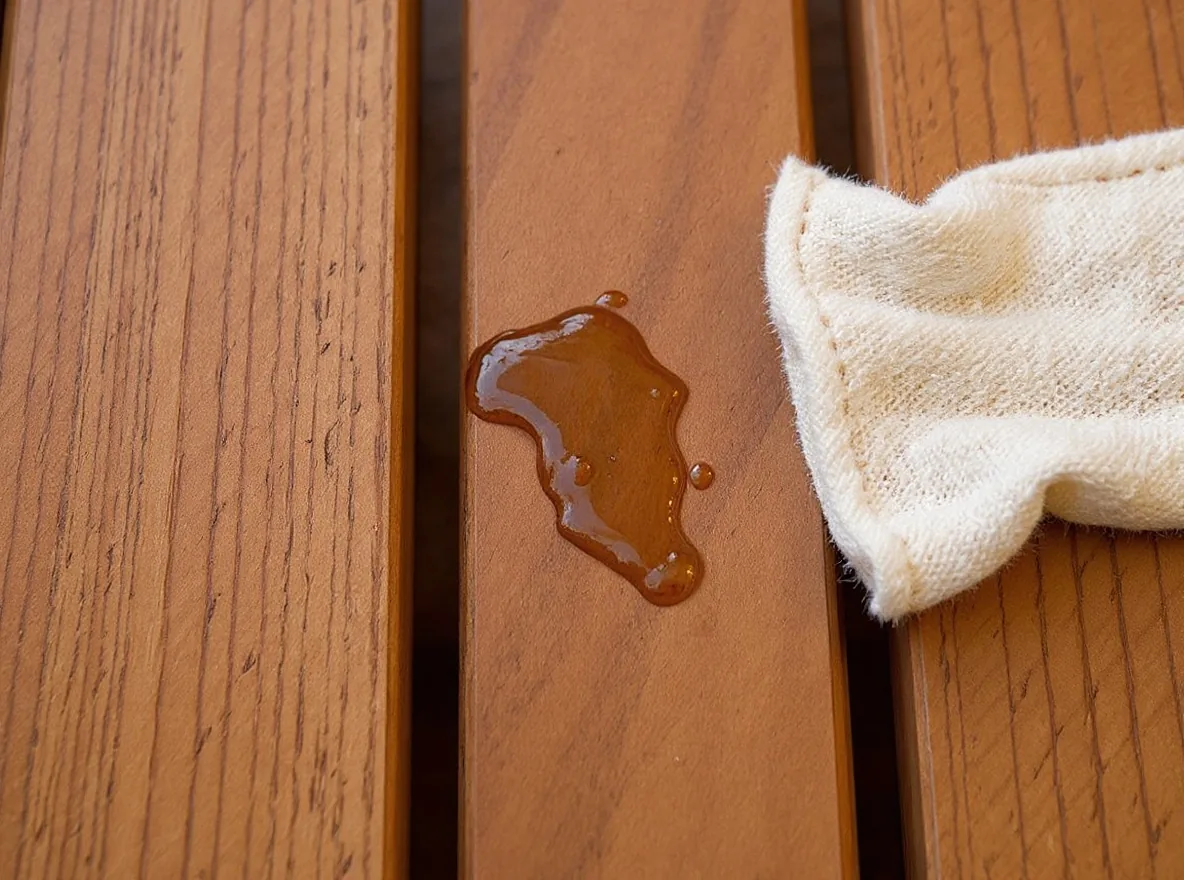
Paraffin oil for saunas is pharmaceutical-grade mineral oil: odourless, without additives, explicitly intended for high temperatures. It enters the surface layer of the wood and reduces absorption of moisture and sweat, which makes future maintenance easier and extends the time between more intensive cleanings.
Procedure:
- The wood must be clean and completely dry
- Oil is applied with a sponge or soft cloth in a thin even layer
- It absorbs for 30–60 minutes
- Wipe off all excess oil with a dry cloth — critical step. Unabsorbed oil on the surface sticks to skin during heating and can create an unpleasant touch
- Heat the sauna briefly (40–50 °C, 30 min, door open) to stabilise polymerisation
Frequency:
- Private sauna 2–3× per week: once per year
- Intensive use (daily, multiple users): 2× per year
Important to know: not all wood species are treated. Cedar and hard local species do not require oil. Thermo alder and abachi benefit from treatment. The specific recommendation depends on the model specification.
Step 07Differences by wood species
KUBIQ uses different wood species in different roles. Cabin exterior — Lunawood thermo pine (Triple 32mm class). Interior — most often brushed thermo alder, optionally abachi for certain configurations, cedar for bespoke projects.
Thermo alder (brushed) — KUBIQ standard for the interior
Thermally treated, dimensionally stable, resistant to colour changes. Brushed surface treatment gives a pleasant tactile experience that remains consistent for years.
- Weekly wiping with a damp cloth
- Monthly cleaning with mild soap
- Paraffin oil annually (benches, backrests)
Abachi
Soft African wood, low heat conductivity — sitting at 90 °C does not burn the skin as with harder woods. It absorbs sweat more, and requires more frequent weekly wiping.
- Weekly wiping (more intensive than thermo alder)
- Monthly cleaning
- Paraffin oil 1–2× per year
Cedar (Western Red)
Naturally resistant to moisture and insects due to a high tannin content. Least maintenance of the three options. The characteristic cedar scent is part of the experience, not a defect — do not try to "clean" it away.
- Weekly wiping is enough
- Paraffin oil is not necessary
The exact wood type for a specific KUBIQ model is stated in the personalised documentation delivered with the sauna.
Step 08BIO mode — separate cleaning
BIO mode requires an aromatherapy reservoir (a small basin or container on the heater for essential oils). That reservoir requires separate maintenance from the rest of the cabin:
- After every BIO session: rinse the reservoir with plain water
- Weekly: more detailed cleaning of the reservoir, removal of essential oil residues (they dissolve in warm water)
- Rule: never leave essential oils in the reservoir longer than one session — concentrated oils at high temperature change character and can become irritating to the respiratory tract
Scents that over time "enter" the wood are not a problem if they are natural and used in reasonable concentration. Eucalyptus, mint, pine, fir — the wood gradually absorbs the testimony of years of use. Many owners value that patina of practice as part of the character of their own sauna.
What to avoid in BIO mode: synthetic perfumed oils, "aroma essences" that are not explicitly for sauna use, scents whose description mentions alcohol carriers.
Step 09What never to do
A strict list of rules that do not bend:
- Pressure washer in the sauna — pressurised water entering cladding and panels destroys insulation
- Bleaches, chlorine products, disinfectants — residues release fumes at 80 °C
- Universal bathroom cleaners — they are not designed for high temperatures
- Varnishes, stains, coloured coatings — sauna wood remains "bare" intentionally
- Essential oils directly on benches — only in the heater reservoir, not on wood
- Leaving the sauna closed and humid after a session — recipe for condensation
- Sanding across the grain — destroys the surface structure
- Sanding the whole surface instead of local stains
- Drying towels inside the sauna — wet textile = permanent moisture in the cladding
- "Refresh" treatments with unverified products — without explicit sauna certification they do not go inside
Frequently asked questions
Does a sauna need disinfection?
No. High session temperatures (>70 °C) with low humidity during the dry heating phase act as natural sterilisation. Disinfectants leave residues that release fumes during heating into a space where people breathe deeply.
How to remove a stubborn stain from a bench?
Fine sanding, P180–P240, in the direction of the wood grain, only the affected area. After sanding: vacuum dust, wipe with a damp cloth, leave to dry. Stains removed by sanding are most often surface stains — sweat that was not wiped while fresh.
Can leftover essential oils remain in the BIO sauna reservoir?
No. Essential oils change chemical character at high temperature — concentrated oils can irritate the respiratory tract. The reservoir is emptied and rinsed after every session.
How often should benches be treated with paraffin oil?
Private sauna 2–3× per week: once per year. Intensive use (daily, several users): 2× per year. Cedar: not necessary. Exact recommendation for your model — in the delivery specification.
What about heater stones?
Check once per month. The stone arrangement must not be too compact — airflow through the heater is critical for correct operation. Stone replacement recommended every 3–5 years for an intensively used heater (cracks, breakage, loss of heat accumulation).
Can I use a vinegar solution for cleaning?
Diluted vinegar (1:10 with water) for removing limescale from heater stones — yes, occasionally. On wood — no. Acid changes the surface character of wood and can create lighter patches in the contact direction.
Next step
A sauna that is maintained regularly does not require major investments over decades. A sauna that is not maintained — requires bench replacement after 5–7 years.
View KUBIQ saunas and specifications → Models, wood species, heaters and configurations — all with maintenance recommendations for the specific cabin.
Talk to the KUBIQ team about service → Service inspection, bench restoration, wooden construction renewal, controller and heater check.