
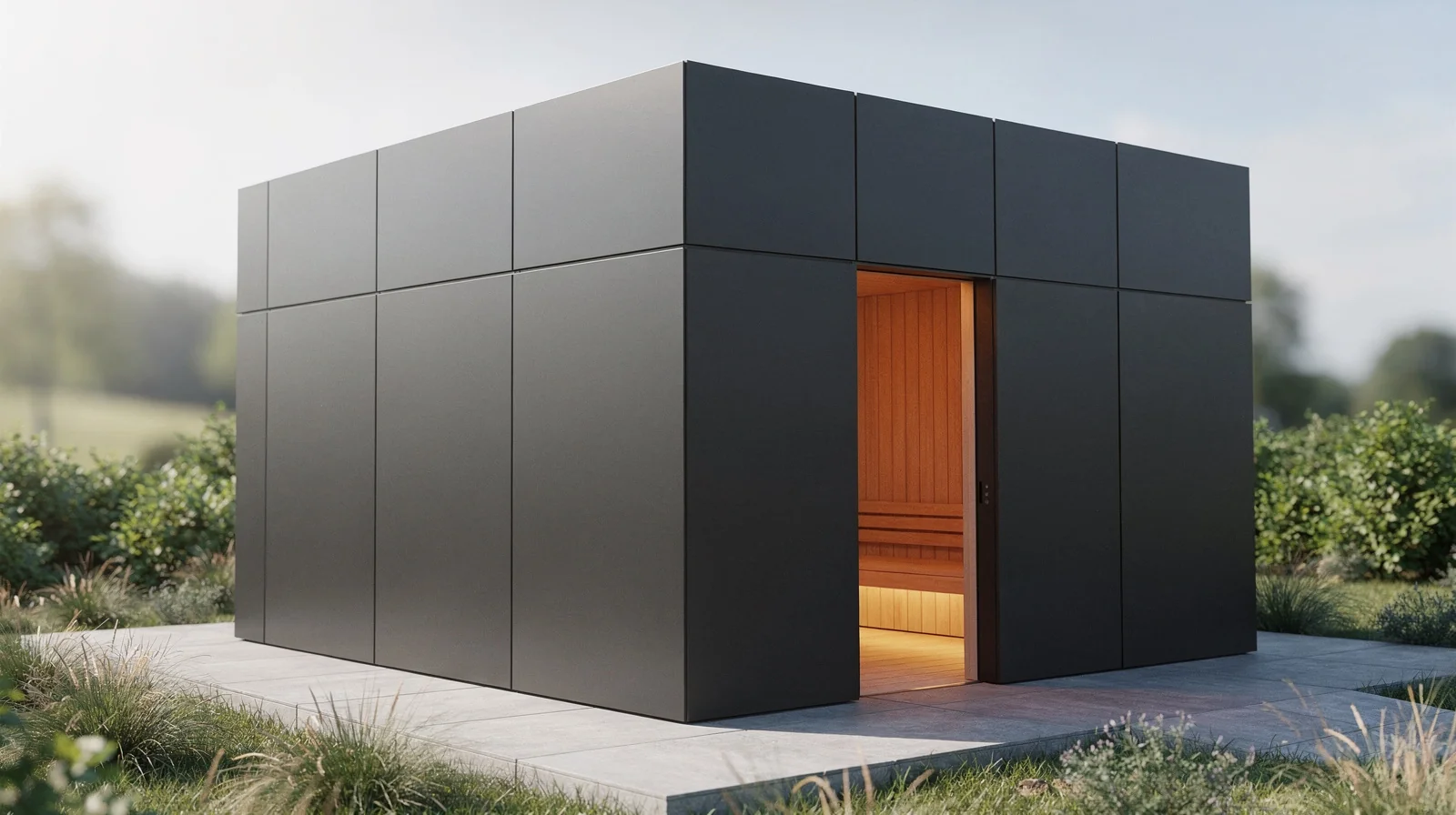
That does not mean MaxCompact is not a good material. It means it has its place — specific projects where exactly that clean, flat, contemporary look is needed. This guide explains what the material is, how we install it when we do use it, and when it makes sense, and when it does not.
Step 01What MaxCompact is
MaxCompact is a high-pressure laminate (HPL) in the form of a compact panel — a thermoset material pressed under high pressure and temperature. It is an exterior-grade material, classified according to EN 438-6, type EDF (for exterior use), not a standard laminate board for interiors.
The core and decorative layers are impregnated with resins, while the exterior protection is a double-hardened acrylic-PUR resin — weather-resistant and UV-stable (lightfast). The manufacturer is Austrian Fundermax.
Step 02Exterior properties
- Weather-resistant and lightfast — colour stability in sun and rain.
- Resistant to scratches and impact.
- Fire classification B-s2,d0 (EN 13501-1).
- Thicknesses 4–20 mm; large panel formats (up to 4100×1854 mm) mean fewer joints.
- Declared for facades (ventilated/rainscreen facade), balconies and exterior use.
Step 03Character and appearance
MaxCompact creates a flat, homogeneous surface — a contemporary, neutral, “technically clean” look. It comes in a wide range of decors and tones (solid colours, wood decors, stone decors, metallic finishes). At KUBIQ, the decor is selected project by project from the Fundermax exterior palette.
The visual language is intentionally different from wood and stone: calm, planar, architectural. For some, that is an advantage; for others it feels too cold — and that is fine, because the material is not for everyone.
Step 04How KUBIQ installs MaxCompact
When the project justifies MaxCompact, the installation works like this:
- An aluminium substructure is mounted onto the KUBIQ construction.
- The panels are bonded to it with special tapes — without screws through the face of the panel.
- The panel thickness is 8–10 mm.
Joints and corners are resolved depending on the project. There are two approaches: either aluminium corner trims are used, or a classic visible joint is left between two panels. With a visible joint, the panel cross-section is visible — the characteristic dark core. Sometimes this is an intentional design detail, and sometimes it is hidden with trims. The decision is part of the specific project design.
Warranty and service life: the same approach as for other KUBIQ materials.
Step 05Maintenance
Low maintenance is a real advantage of MaxCompact: no coatings, no sanding, and a closed surface that does not absorb. Occasional cleaning with water is enough. Joints are solved mechanically (trims or visible joint), so there is no additional joint maintenance.
Step 06When MaxCompact makes sense, and when it does not
- Most common case — it does not make sense on a small sauna: many edges and joints make the execution complex, while the result does not justify that complexity. In that case, we will suggest another material.
- It makes sense selectively: a specific project that needs exactly that clean, flat, contemporary look without wood grain; larger or simpler surfaces with fewer joints.
- In character terms: for someone who does not want to watch a material patinate over time and wants the lowest maintenance level — MaxCompact delivers that. But it does not remove the question of execution complexity on a small object.
Step 07What MaxCompact is not
- It is not a cheap laminate board for interiors — it is an exterior-grade compact HPL (EN 438-6 EDF), declared for facades.
- It is not wood — it intentionally does not have the living character or patination of wood. That is a feature, not a flaw.
- It is not “completely joint-free” — large formats reduce joints, but a panel facade has its own grid logic, which is exactly why it is demanding on a small object.
MaxCompact is a material KUBIQ approaches selectively. If you are looking for a clean modern surface and the project can support it — we install it properly. If the object is small and full of joints, we will honestly say there is a better route.