
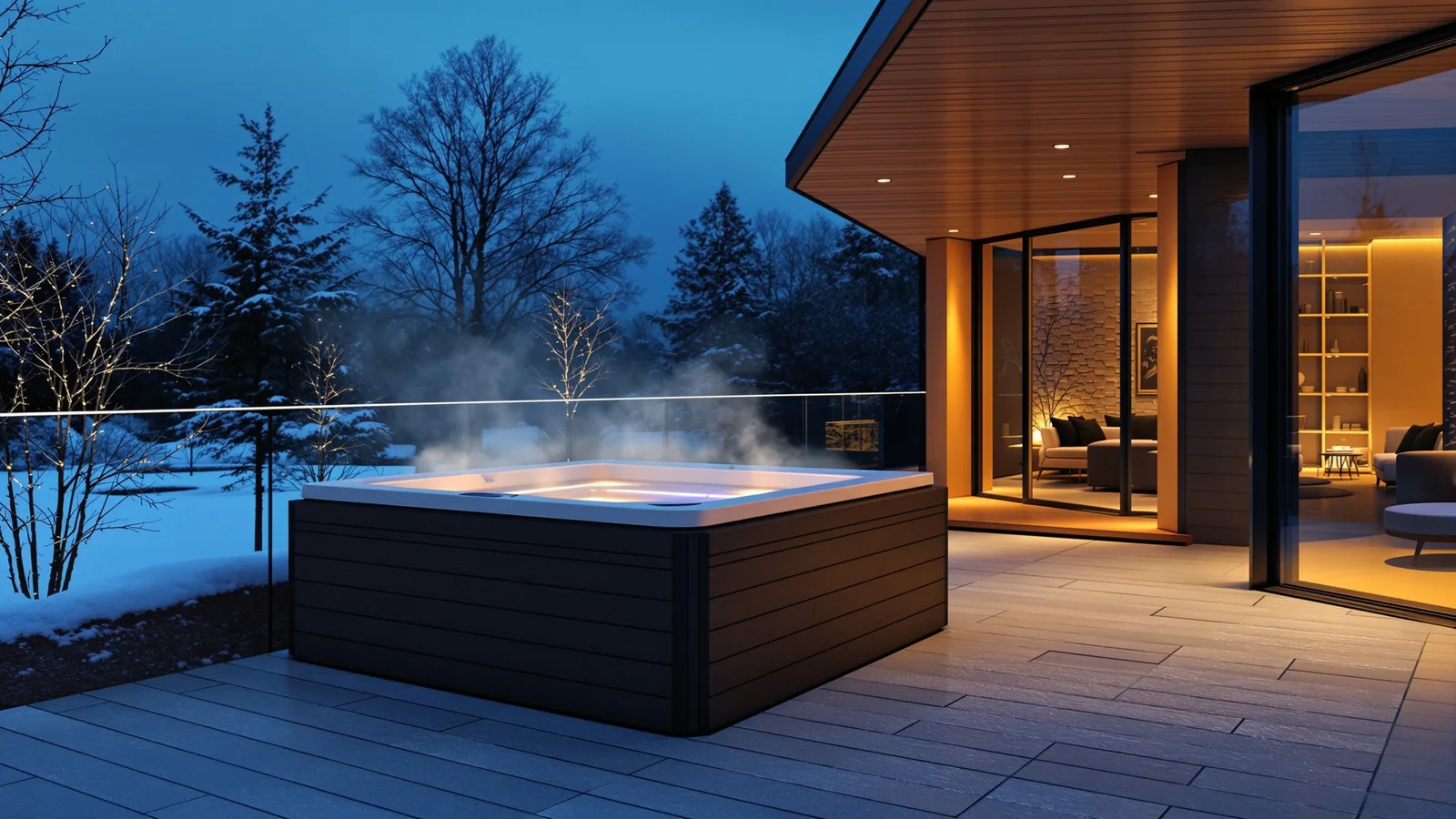
Most people use „jacuzzi“, „hydromassage pool“ and „hot tub“ as synonyms. In conversation that’s fine. In a buying decision it isn’t — because under those names live products of very different purpose, construction and price.
The difference that actually decides isn’t the name, but whether the tub is built to stand outside all year and run at outdoor temperatures — or is a portable unit that assumes shelter and lighter use. They’re two different things that happen to share a shape.
This guide breaks down the terminology, what makes a tub outdoor-rated, how it’s heated, what winter operation takes, what to watch for in installation and water care, and when an outdoor hot tub isn’t the right choice at all.
Step 01Why „jacuzzi“ and „hot tub“ get confused
Jacuzzi is a company’s trademark that became a generic word — like „hoover“ or „thermos“. Technically it names that company’s hydromassage product; in everyday speech it means any tub with jets. That’s why the word itself is useless for a decision.
Three different things live under that umbrella:
A built-in hydromassage bath — part of a bathroom, plumbed to a fixed supply and drain, for indoor use.
A portable spa (often called a whirlpool) — a self-contained acrylic tub with jets and a heater. It works, but it assumes a sheltered spot and lighter, seasonal use.
An outdoor hot tub — a tub engineered to stand outside permanently and run at outdoor temperatures all year. Same kind of shell as a spa, but with insulation, sealing and heating sized for the elements.
A KUBIQ hot tub belongs to the third category. An acrylic shell with proper insulation and an integrated heater — not a portable unit for occasional summer use.
Step 02What makes a tub outdoor-rated, not a portable spa
On paper a portable spa and an outdoor hot tub look alike. The difference shows up in the first winter. Specifically, an outdoor tub is defined by a few things a spa doesn’t have:
A UV-stable shell. The acrylic is the same material as a spa’s, but for outdoor use it has to resist UV — otherwise sun gradually fades and degrades the surface.
Insulation. Full-foam / PU insulation around the shell and inside the cabinet holds heat when it’s cold outside. Without serious insulation, heating in sub-zero temperatures simply leaks into the air.
A sealed cabinet. Resistant to moisture and UV, it protects the equipment — heater, pumps, pipes — from the weather.
Freeze protection. Pipes and pumps must be protected so the water doesn’t freeze in winter. That’s the difference between a tub that runs all year and one you have to drain for the season.
A heater sized for outdoor temperatures. It has to raise and hold the temperature when the surroundings are cold, not just in a warm room.
Step 03Heating: an electric integrated heater (and a wood-fired option)
The default is an electric integrated heater — built into the tub’s system, it heats the water and holds the set temperature automatically. It runs on mains power, with no firing or supervision.
The key to running cost isn’t the heater itself, it’s insulation. A well-insulated tub with its cover on spends most of its time merely maintaining temperature, not heating from cold. That’s why insulation is what makes electric heating economical outdoors.
For certain formats a wood-fired heater is also possible — for those who want fire as part of the ritual and independence from mains power. It isn’t the default: it has its own heat-up and maintenance logic and asks for more involvement. We mention it as an option, not a recommendation.
Step 04Year-round operation: what it actually takes
Winter is the test. An outdoor hot tub that runs all year needs good insulation, a quality thermal cover, circulation that prevents freezing, and a heater that holds temperature in sub-zero conditions.
The thermal cover isn’t an accessory — it’s the main driver of running cost. An open tub loses heat fast; a covered one holds it. Most of the heating bill is decided by how disciplined you are about keeping the cover on.
This is exactly what a portable or cheap spa doesn’t solve. Without insulation and freeze protection, an „outdoor“ tub becomes a burden in winter: either you shut it down and drain it, or you pay for heating that escapes into the air.
Year-round use is also why an outdoor hot tub makes sense as an investment rather than a cost — it’s used through the whole season in which simpler solutions sit idle.
Step 05Outdoor installation: what to watch for
Base and load-bearing. A tub full of water with people in it is far heavier than empty. The base has to carry that filled weight — level, stable and sized for the real load.
Drainage. You need to plan for controlled emptying when changing water or servicing.
Power. An electric heater needs a suitable, dedicated connection — planned before, not after, the tub is in place.
Delivery access. The tub arrives assembled, so check that the route — doors, stairs, approach — clears its dimensions.
Positioning. Proximity to the house or sauna, privacy, the view and shelter from wind all directly affect how much the tub actually gets used.
The technical prerequisites for base, power and drainage are covered in more detail in the Site preparation guide.
Step 06Water care outdoors
An outdoor tub means the water interacts with its surroundings — leaves, dust, weather changes. A filtration and sanitisation system keeps the water clean between changes.
Realistically, an outdoor tub needs a routine: checking the chemistry, cleaning the filter, the occasional water change. It isn’t „fill it and forget it“, but it’s predictable and quick once you settle into a rhythm. The cover helps here too — it keeps debris out and reduces how often the water needs attention.
If you want no involvement with water care at all, a hot tub probably isn’t the right product — and it’s useful to know that beforehand, not after.
Step 07A hot tub as part of a wellness space
A hot tub rarely stands alone. It makes the most sense as part of a whole — alongside a sauna, as the warm half of a hot/cold contrast, or as a place to relax afterwards. The sauna → cold → warm-tub sequence is the full cycle; the physiology is explained in the Contrast therapy guide.
KUBIQ’s approach to the hot tub starts from that whole. We don’t pick the model for you, but we help tell the formats apart and choose what makes sense for your space and how you’ll use it. The tub arrives assembled and tested; we deliver, install and explain it. Service is local — you don’t call abroad — with a 2-year warranty on materials and equipment. For owners who rent out, a fast response to a fault is part of the maths, because downtime means lost bookings.
Step 08When an outdoor hot tub is NOT the right choice
The strongest sign someone knows what they’re talking about is that they’ll also tell you when something doesn’t make sense. An outdoor hot tub probably isn’t the right choice in these situations:
The space has no infrastructure. If there’s no power, drainage or stable base and you don’t plan to sort them, a hot tub is premature.
The goal is only cold recovery. If you’re after cold therapy and recovery alone, a cold plunge is the simpler, more direct choice.
You don’t want a water-care routine. A hot tub needs regular, if predictable, attention to the water. Without it, it doesn’t run well.
The need is only occasional. For a couple of weeks of summer soaking a year, a serious insulated outdoor hot tub probably exceeds the real need.
An outdoor hot tub pays off for those who use it through the whole year and value it as a permanent part of the space. For everything else there are simpler solutions — and it’s better to know that before deciding.